
Surface resistivity vs. volume resistivity is an important topic when evaluating the electrical properties of plastic materials. Although both parameters measure electrical resistance, they describe different behaviors: one focuses on the material’s surface, while the other evaluates its internal electrical properties.
When selecting antistatic additives or evaluating the electrical properties of plastic materials, surface resistivity and volume resistivity are two important parameters.
These terms are sometimes used interchangeably, but they describe different electrical properties. Understanding their differences helps plastic manufacturers select suitable materials and evaluate antistatic performance more accurately.
1. What Is Surface Resistivity?
Surface resistivity refers to the resistance to electrical current flowing along the surface of a material.
In plastic applications, it indicates how easily electrical charges can move across the material’s surface.
A lower surface resistivity generally indicates that electrical charges can dissipate more easily along the surface, while a higher value indicates stronger electrical resistance.
Surface resistivity is particularly important for applications where static electricity accumulates on the outer surface of plastic products.
Typical applications include:
- Electronic component trays and packaging
- Antistatic plastic containers
- Plastic films and sheets
- Industrial plastic components
- Electronic product housings
Surface resistivity is commonly reported in ohms (Ω), sometimes written as ohms per square (Ω/sq).
2. What Is Volume Resistivity?
Volume resistivity refers to the resistance to electrical current flowing through the interior of a material.
Unlike surface resistivity, which focuses on the material’s outer surface, volume resistivity evaluates the electrical resistance of the material’s bulk.
It is an important indicator of the electrical insulating properties of plastics.
A higher volume resistivity generally indicates better electrical insulation, while a lower value indicates that current can pass through the material more easily.
Typical applications include:
- Electrical insulation components
- Electronic housings and parts
- Insulating plastic sheets
- Conductive plastic materials
- Antistatic and electrostatic-control materials
Volume resistivity is commonly expressed in Ω·cm or Ω·m.
3. 5 Key Differences: Surface Resistivity vs. Volume Resistivity
| Comparison | Surface Resistivity | Volume Resistivity |
|---|---|---|
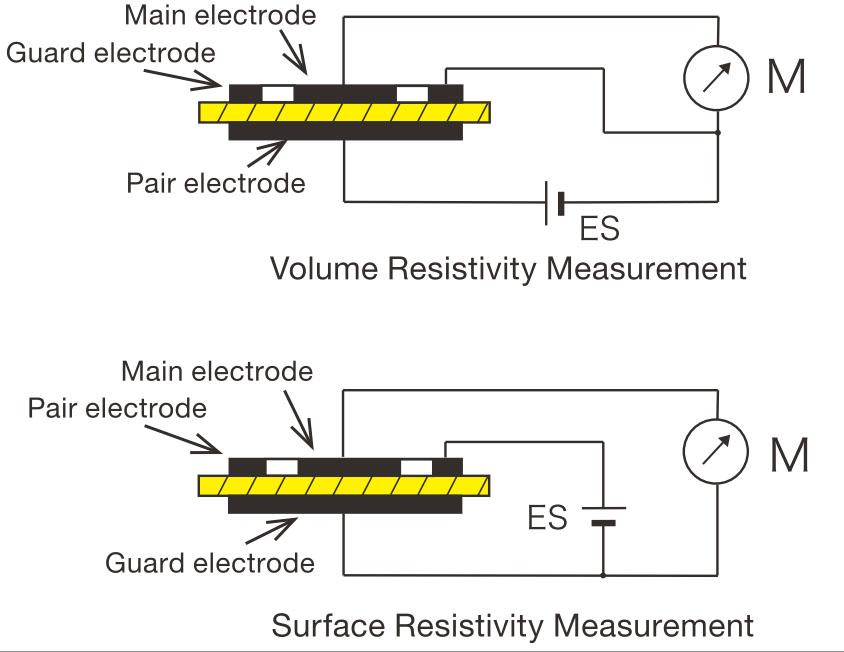
| Measurement | Along the material surface | Through the material |
| Main focus | Surface electrical behavior | Internal electrical behavior |
| Common units | Ω or Ω/sq | Ω·cm or Ω·m |
| Main application | Surface static control | Bulk insulation or conductivity |
| Testing approach | Electrodes on the same surface | Electrodes on opposite sides |
The two parameters provide different information. A material may have different surface and volume resistivity values, so one cannot automatically be used to predict the other.
4. Why Are Both Parameters Important for Antistatic Plastics?
For plastic manufacturers, understanding these two parameters is especially important when developing permanent antistatic materials.
For example, an antistatic plastic tray used for electronic components needs to control static electricity on its surface to reduce the risk of electrostatic discharge.
However, the electrical behavior inside the material may also matter, depending on the product’s design and application.
Permanent antistatic additives can modify the electrical behavior of plastic materials. Their performance should therefore be evaluated using appropriate test methods and application-specific requirements.
It is also important to remember that resistivity measurements can be affected by:
- Temperature and relative humidity
- Material composition and resin type
- Additive concentration and dispersion
- Sample thickness and surface condition
- Testing voltage and electrification time
For reliable comparisons, test conditions should be consistent.
Technical References
For further information about electrical resistance and resistivity testing, you can refer to the following international standards organizations:
International Electrotechnical Commission (IEC) – IEC 62631
ASTM International – ASTM D257
5. Which Resistivity Should You Measure for Antistatic Plastics?
There is no single answer for every plastic application.
Choose surface resistivity as a key evaluation parameter when:
- Your product needs surface static control.
- You manufacture antistatic packaging or trays.
- Static charge accumulation on the surface is your main concern.
Consider volume resistivity when:
- You need to evaluate the electrical insulation of a plastic material.
- Electrical properties throughout the material are important.
- You are developing bulk conductive or antistatic plastics.
For some applications, both measurements are necessary to obtain a more complete understanding of the material’s electrical behavior.
6. How Does BOMAN Support Permanent Antistatic Plastic Applications?
At BOMAN, we provide permanent antistatic additive solutions for various plastic resins, including PP, PE, ABS, PC, PET and PA.
We focus on helping plastic manufacturers improve antistatic performance through suitable material selection and formulation development.
Whether you are producing electronic packaging, industrial plastic components or other antistatic plastic products, understanding your required resistivity level is an important starting point.
Looking for a suitable permanent antistatic solution?
Contact BOMAN to discuss your resin type, processing method and target electrical performance.
BOMAN – Your Partner in Permanent Antistatic Solutions.