
When choosing an antistatic solution for plastic products, manufacturers often compare surface coating vs. internal additives. Both approaches help reduce static electricity, but they work differently and offer distinct advantages in terms of durability, processing, and application.
To reduce static buildup, manufacturers commonly use two approaches: surface coating and internal additives.
Although both methods help improve the antistatic performance of plastic products, they work in different ways and offer different advantages.
Understanding these differences can help manufacturers select the right solution for their applications.
1. How Does Surface Coating Work?
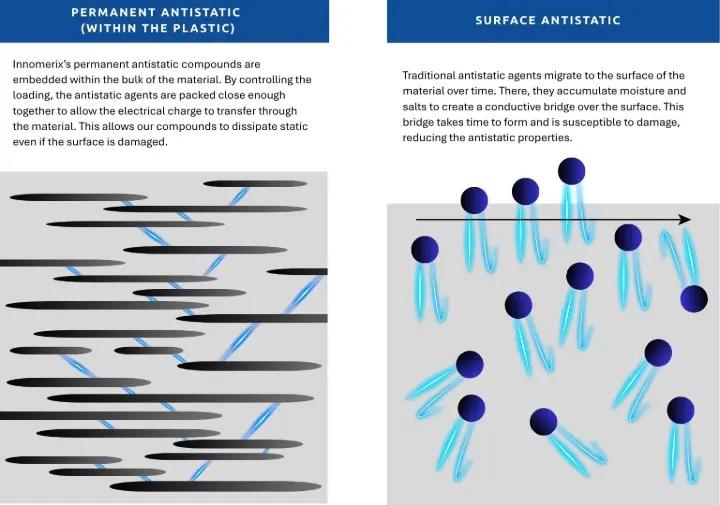
Surface coating involves applying an antistatic agent or functional coating to the surface of a finished plastic product.
The coating forms a thin layer on the plastic surface, helping reduce static accumulation by improving surface conductivity or controlling surface charge.
Advantages:
- Can be applied to finished plastic products.
- Suitable for applications where surface treatment is preferred.
- Does not necessarily require changes to the original resin formulation.
- Can provide relatively quick antistatic performance.
Limitations:
- The coating may be removed by washing, wiping, or friction.
- Performance may decrease over time.
- Additional coating and drying processes may be required.
- Uniform coating can be challenging for complex product shapes.
Surface coating is often suitable for applications where post-processing treatment is convenient and surface-level functionality is sufficient. For a basic understanding of static electricity and how electric charges accumulate on materials, you can refer to this technical overview from Encyclopaedia Britannica – Static Electricity.
2. How Do Internal Antistatic Additives Work?
Internal antistatic additives are incorporated directly into the polymer during compounding, extrusion, or injection molding.
Unlike surface coatings, these additives become part of the plastic material. Depending on their chemistry and formulation, they can migrate or orient toward the surface and form an antistatic layer that helps dissipate static charges.
Permanent antistatic additives, such as polymer-based PEEA or PEBA systems, are designed to provide more durable antistatic performance than conventional migrating antistatic agents.
Advantages:
- Incorporated directly into the resin during processing.
- No separate surface coating process is required.
- Antistatic functionality is integrated into the material.
- Can offer better resistance to washing and surface abrasion, depending on the formulation and application.
- Suitable for injection molding, extrusion, and film applications when the grade is properly selected.
Limitations:
- Must be compatible with the target polymer.
- Requires formulation and dosage optimization.
- Processing conditions may affect final performance.
- Initial material formulation and testing are necessary.
Internal additives are particularly suitable for manufacturers seeking integrated antistatic functionality throughout the production process.
3. Key Differences Between Surface Coating and Internal Additives
Surface Coating vs. Internal Additives: Key Differences
| Comparison | Surface Coating | Internal Additives |
|---|---|---|
| Application method | Applied to the product surface | Mixed into the resin |
| Processing stage | Usually after molding or film production | During compounding or molding |
| Antistatic mechanism | Functional surface layer | Additive incorporated into the polymer |
| Washing resistance | Depends on coating adhesion and chemistry | Can offer better durability, depending on formulation |
| Abrasion resistance | Coating may wear off | No separate coating layer to wear off |
| Additional process | Usually required | Usually no separate coating process |
| Formulation requirements | Surface treatment compatibility | Resin compatibility and dosage optimization |
4. Which Solution Should You Choose?
When comparing surface coating vs. internal additives, manufacturers should consider not only the initial antistatic effect but also long-term durability, production efficiency, and maintenance requirements.The right solution depends on the application, production process, and required antistatic performance.
Choose surface coating when:
- You need to treat already-manufactured plastic products.
- Your application requires a surface-specific functional layer.
- Post-processing is already part of your production line.
Choose internal additives when:
- You want antistatic functionality integrated into the plastic material.
- You prefer to avoid a separate coating process.
- Your products require more durable antistatic performance.
- You need an antistatic solution compatible with injection molding, extrusion, or film production.
For applications involving frequent handling, washing, or surface friction, internal antistatic additives may offer practical advantages. However, actual performance should always be verified under the intended operating conditions.
5. How Does BOMAN Support Your Antistatic Needs?
BOMAN specializes in permanent antistatic additives and conductive material solutions for plastic applications.
Our product portfolio includes polymer-based permanent antistatic additives for different resin systems, including:
- PP and PE
- ABS and PC/ABS
- PA6 and PA66
- TPU
- Other selected plastic applications
We also provide conductive carbon black and carbon nanotube solutions for applications requiring higher electrical conductivity.
Whether you are developing plastic packaging, electronic components, industrial plastic parts, or automotive applications, selecting the right additive starts with understanding your resin, processing method, and target surface resistivity.Choosing between surface coating vs. internal additives depends on your resin type, production process, and required antistatic performance.
Looking for a suitable antistatic solution for your plastic products?
Contact BOMAN to discuss your resin system, application, and performance requirements.
Website: https://bomanmaterials.com/