
Antistatic agents for food packaging films play an important role in reducing static electricity during film production, converting, and packaging. Choosing the right additive requires careful consideration of food contact compliance, migration behavior, transparency, processing compatibility, and long-term antistatic performance.
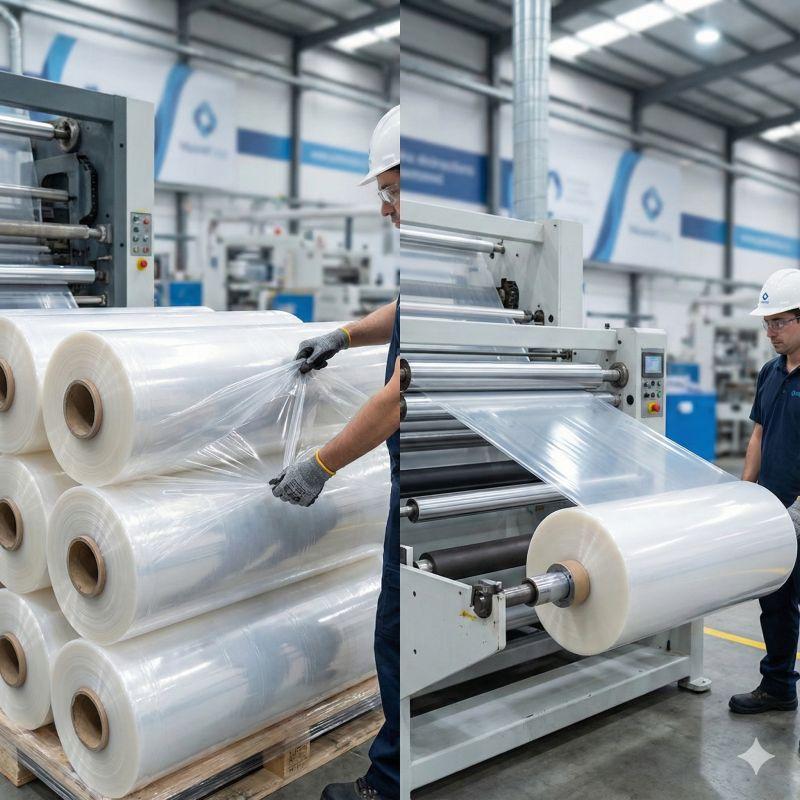
Food packaging films are widely used for fresh food, snacks, frozen food, beverages, and other consumer products. During film production, converting, filling, and transportation, static electricity can cause dust attraction, film blocking, feeding difficulties, and packaging efficiency problems.
Adding an antistatic agent can help reduce these issues. However, food packaging applications require more careful material selection than ordinary plastic packaging.
Here are five important factors to consider.
1. Antistatic Agents for Food Packaging Films: Food Contact Compliance
Food safety is the most important consideration.
Antistatic agents used in food packaging films should be evaluated according to the applicable food contact regulations in the target market.
Before selecting an antistatic additive, check:
- Whether the additive is suitable for the intended food contact application.
- Whether its composition meets the applicable regulatory requirements.
- Whether supporting food contact compliance documents are available.
- Whether migration testing is required for the final film.
Important: General RoHS or REACH compliance does not automatically mean that a material is suitable for food contact applications.
When selecting antistatic agents for food packaging films, migration behavior and long-term stability should be carefully evaluated.

2. Migration and Long-Term Stability
Traditional migratory antistatic agents work by moving toward the film surface and forming a conductive moisture layer.
Although this mechanism can reduce static electricity, it may also cause problems such as:
- Additive migration or surface blooming.
- Changes in surface appearance.
- Potential transfer to the packaged food.
- Reduced performance after washing or surface contact.
For food packaging films, migration behavior and long-term stability should be carefully evaluated.
Permanent antistatic additives based on polymeric systems may offer an alternative approach, depending on their formulation and food contact suitability.
3. Transparency and Film Appearance
Many food packaging films require high transparency and an attractive surface appearance.
An unsuitable antistatic additive may affect:
- Film transparency and haze.
- Surface gloss.
- Color and visual consistency.
- Film surface quality.
This is especially important for clear PE, PP, and multilayer packaging films.
Therefore, the additive should be evaluated not only for antistatic performance but also for its influence on the final film appearance.
4. Processing Compatibility
Food packaging films are commonly produced through blown film extrusion, cast film extrusion, and other film processing technologies.
Different resins and processing conditions require different additive solutions.
Important factors include:
- Compatibility with the base resin, such as PE or PP.
- Processing temperature and thermal stability.
- Dispersion and feeding performance.
- Influence on film extrusion and winding.
- Mechanical properties of the finished film.
The recommended additive and loading level should be determined through trials based on the actual formulation and processing conditions.
5. Antistatic Performance Under Actual Conditions
A good antistatic solution should work under the actual storage and application conditions.
Food packaging films may experience different temperatures and humidity levels during production, storage, and transportation.
When evaluating an antistatic agent, consider:
- Surface resistivity.
- Antistatic performance at different humidity levels.
- Performance after aging.
- Stability during storage and transportation.
- Whether the required performance can be maintained throughout the intended service life.
Testing should be conducted under controlled and representative conditions.
The selection of antistatic agents for food packaging films should always balance food contact requirements, film quality, and reliable antistatic performance.
Conclusion
Selecting an antistatic agent for food packaging films is not simply about achieving a lower surface resistivity.
Food contact compliance, migration behavior, transparency, processing compatibility, and long-term antistatic performance must all be considered.
At BOMAN, we focus on permanent antistatic solutions for plastic applications. We also provide technical support for evaluating additive compatibility and performance according to different resin systems and processing requirements.
Looking for an antistatic solution for PE or PP food packaging films?
Contact BOMAN to discuss your resin type, film processing method, and target antistatic performance.
Note: Food contact suitability must be confirmed for the specific additive formulation and final application. Compliance should be supported by appropriate documentation and testing.