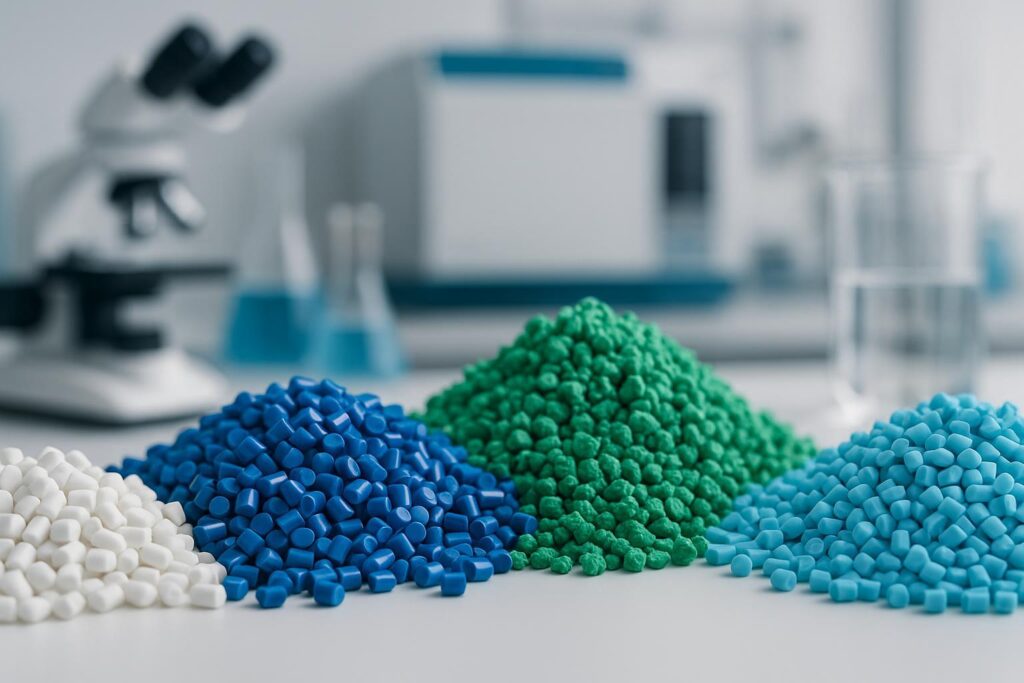
Why Do Many Compounders Struggle to Achieve Stable Permanent Antistatic Performance?

Introduction There is a common understanding among plastic compounders: small-molecule antistatic agents are relatively easy to process, but their performance is often short-lived. They may migrate to the surface, cause blooming, and lose effectiveness after washing. By comparison, polymer-based permanent antistatic additives, such as polyether-amide (PEEA/PEBA) systems, are much more difficult to process. However, they

Why Do Many Compounders Struggle to Achieve Stable Permanent Antistatic Performance? Read More »
Polymer-Based Antistatic Additives: A Cleaner Alternative for High-Performance ESD Plastics

In plastic antistatic applications, carbon black, carbon nanotubes (CNTs), and surface coatings have been widely used for years. However, as semiconductor, electronics, optical and cleanroom applications demand higher cleanliness, stability and design flexibility, the limitations of traditional solutions are becoming more apparent.   ## Why Are Traditional Antistatic Solutions Facing Challenges?   **Carbon black systems**

Polymer-Based Antistatic Additives: A Cleaner Alternative for High-Performance ESD Plastics Read More »

Bleed‑out and Delamination of Permanent Antistatic Masterbatch in Natural PC

Defects including die build‑up, surface bloom, delamination and silvery streaks often appear in PC components using polyether‑amide permanent antistatic masterbatch. These problems are generally not triggered by excessive masterbatch addition. Main drivers are carrier‑PC incompatibility, thermal degradation, additive conflicts, improper screw shear and poor PC substrate condition (moisture, recycled material). The antistatic polymer itself is

Bleed‑out and Delamination of Permanent Antistatic Masterbatch in Natural PC Read More »

Permanent Antistatic Additives for ABS: Reducing Static Electricity and Improving Product Performance

What Is ABS? ABS (Acrylonitrile Butadiene Styrene) is one of the most widely used engineering plastics. It offers excellent impact resistance, good dimensional stability, and an attractive surface finish, making it a preferred material for injection-molded products. ABS is commonly used in: Electronic housings Home appliances Automotive interior parts Industrial equipment Consumer products Its excellent

Permanent Antistatic Additives for ABS: Reducing Static Electricity and Improving Product Performance Read More »

Long-Term vs. Short-Term Antistatic: How Big Is the Difference?

Both materials can pass an antistatic test. So why can their prices differ by 50% or even 100%? To an outsider, both are simply “antistatic materials.” To a plastics professional, however, long-term and short-term antistatic solutions are fundamentally different. Choosing the wrong one can lead to unstable surface resistivity, dust attraction, coating or printing problems,

Long-Term vs. Short-Term Antistatic: How Big Is the Difference? Read More »

Can Permanent Polymer Antistatic Additives Really Withstand Repeated Washing?

For electronics manufacturers, plastic compounders, and packaging producers, antistatic performance is often expected to remain stable throughout the service life of a product. However, a common problem with conventional antistatic materials is that their performance may gradually decline after repeated washing, wiping, or long-term use. Surface resistivity increases, static electricity becomes more difficult to dissipate,

Can Permanent Polymer Antistatic Additives Really Withstand Repeated Washing? Read More »

Antistatic ≠ Conductive: 5 Common Misconceptions That Can Cause Major Problems in Modified Plastics

In the modified plastics and ESD protection industry, one of the most common—and potentially costly—misconceptions is this: “If a material is conductive, it must provide good antistatic protection.” In reality, antistatic and conductive materials are not the same thing. This misunderstanding can lead to repeated failures when selecting materials for plastic components, ESD workstations, electronic trays,

Antistatic ≠ Conductive: 5 Common Misconceptions That Can Cause Major Problems in Modified Plastics Read More »

5 Common Mistakes to Avoid When Using Permanent Antistatic Masterbatch for PP, ABS & PE

5 common mistakes that can lead to unstable antistatic performance, higher costs, and production problems. If you work with injection molding, extrusion, or blow molding, you probably know that static electricity can become a hidden problem in plastic processing. PP, ABS, and PE are three of the most widely used plastic materials. They are commonly

5 Common Mistakes to Avoid When Using Permanent Antistatic Masterbatch for PP, ABS & PE Read More »

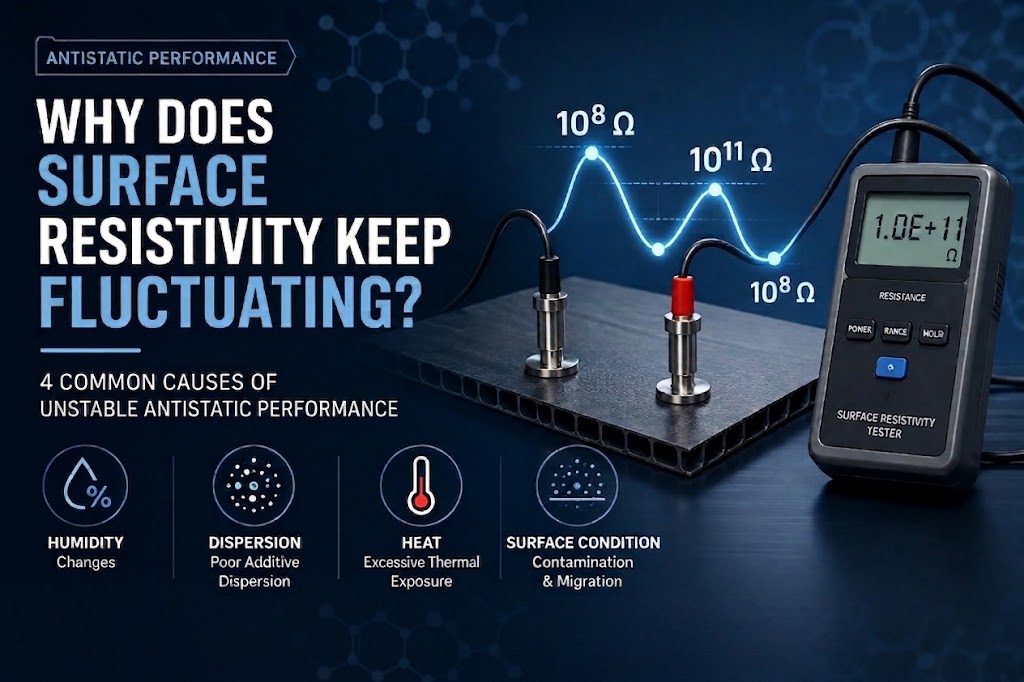
Why Does Surface Resistivity Keep Fluctuating? 4 Common Causes of Unstable Antistatic Performance

If you work in antistatic modification, plastics processing, or material purchasing, you have probably experienced this frustrating situation: The same material, the same mold, and the same testing equipment can show a surface resistivity of 10⁸ Ω and pass the requirement today, but suddenly rise to 10¹¹ Ω tomorrow, only to return to a normal level later.

Why Does Surface Resistivity Keep Fluctuating? 4 Common Causes of Unstable Antistatic Performance Read More »

Plastic Static Problems Keep Coming Back? A Practical Guide to Antistatic Additives, Masterbatch Selection & Conductive Modification

If you work in plastic compounding, injection molding, extrusion, or plastic packaging, you have probably experienced static electricity problems. Finished products attract dust. Printing and coating adhesion becomes inconsistent. Electronic components may be exposed to electrostatic discharge. Dry conditions make static problems worse. And sometimes, an antistatic solution that works well initially gradually loses performance

Plastic Static Problems Keep Coming Back? A Practical Guide to Antistatic Additives, Masterbatch Selection & Conductive Modification Read More »

Product Enquiry