
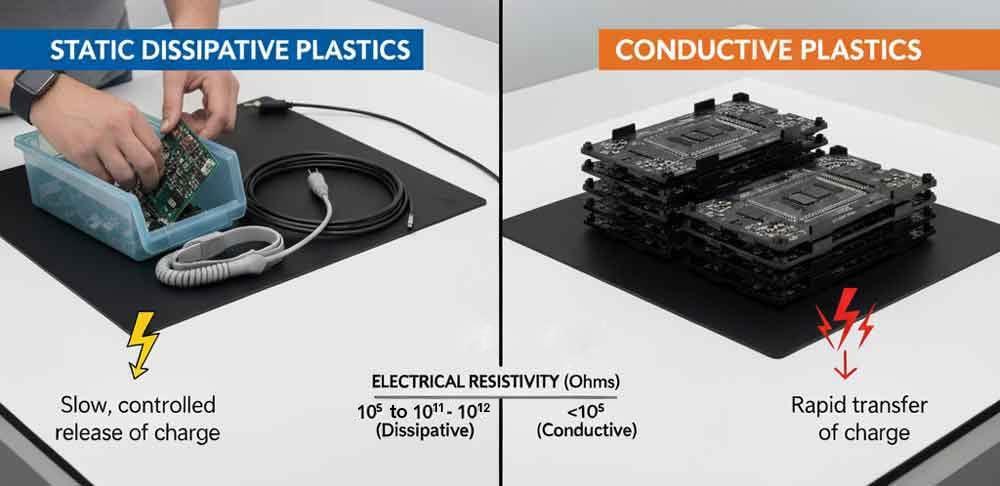
In the modified plastics and ESD protection industry, one of the most common—and potentially costly—misconceptions is this:
“If a material is conductive, it must provide good antistatic protection.”
In reality, antistatic and conductive materials are not the same thing.
This misunderstanding can lead to repeated failures when selecting materials for plastic components, ESD workstations, electronic trays, packaging films, housings, and other applications.
The consequences can include failure to meet ESD requirements, unsuitable electrical resistance, component damage, product rejection, rework, customer complaints, and production losses.
Although both antistatic and conductive materials are related to controlling electrical charge, they differ significantly in their electrical resistance, charge dissipation behavior, formulation design, and application requirements.
1. The Key Difference: They Belong to Different Resistance Ranges
The most important parameter when distinguishing antistatic and conductive plastics is their electrical resistance.
However, the exact classification can vary depending on the applicable ESD standard and test method. Therefore, resistance values should always be evaluated according to the specific application and customer specification.
01 — Antistatic / ESD-Dissipative Materials
Typical function: Controlled and gradual dissipation of electrostatic charge.
Antistatic materials are designed to prevent static charge from accumulating on the surface. Instead of allowing charge to build up and discharge suddenly, they provide a controlled path for charge dissipation.
Their key objective is:
“Dissipate static charge in a controlled manner while maintaining electrical safety.”
Typical applications include:
Electronic component trays
IC and semiconductor packaging
PCB carriers
ESD workstations and accessories
Electronic housings
Sensor components
Cleanroom plastic components
Antistatic films and packaging materials
For these applications, excessively low resistance is not necessarily better.
The goal is not simply to make plastic “more conductive,” but to achieve the appropriate resistance level for the required ESD protection.
02 — Conductive Plastics
Typical function: Rapid charge and current conduction.
Conductive plastics are formulated to provide much higher electrical conductivity than conventional antistatic or dissipative materials.
They are commonly used where electrical conduction, grounding, electromagnetic interference (EMI) shielding, or rapid charge transfer is required.
Typical conductive fillers include:
Conductive carbon black
Graphite
Carbon fiber
Metal fillers
Other conductive additives
The design objective is fundamentally different:
“Provide a low-resistance path for electrical charge or current.”
Therefore, conductive plastics should not automatically be considered a better alternative to antistatic materials.
2. Three Common Misconceptions You Need to Avoid
01 — Misconception: The More Conductive, the Better the Antistatic Performance
This is one of the most common mistakes in modified plastics.
Many people assume:
Lower resistance = better conductivity = better ESD protection.
But this is not necessarily true.
In precision electronics, semiconductor packaging, and ESD-sensitive environments, the objective is not simply to achieve the lowest possible resistance.
The key is to control and dissipate electrostatic charge safely.
If a material is selected with an electrical resistance that is too low for the application, it may no longer meet the required ESD material classification or customer specification.
Therefore:
Antistatic protection is about controlled charge dissipation—not simply maximum conductivity.
02 — Misconception: Antistatic and Conductive Plastics Can Be Used Interchangeably
Antistatic materials may have a certain degree of electrical conductivity, but that does not mean they are equivalent to conductive plastics.
Their formulation strategies can be completely different.
Antistatic / dissipative plastics
Depending on the polymer system and performance requirements, formulations may use:
Permanent antistatic additives
Surface-active antistatic agents
Appropriate conductive or dissipative additives
Other functional modifiers
The objective is to control surface electrical properties and provide stable charge dissipation.
Conductive plastics
Conductive formulations may use relatively high levels of:
Carbon black
Graphite
Carbon fiber
Metal-based fillers
Other conductive materials
The objective is to significantly reduce electrical resistance and provide a reliable conductive pathway.
Using the wrong material for the application can result in:
Failure to meet ESD specifications
Unsuitable electrical resistance
Poor product performance
Component protection issues
Additional formulation and production costs
03 — Misconception: If the Material Does Not Generate Static, It Is Qualified
Another common mistake is to judge antistatic performance only by appearance or everyday handling.
For example:
The material does not visibly attract dust.
No obvious sparks are observed.
Static charge does not seem to accumulate.
These observations alone do not prove that a plastic material meets an ESD requirement.
Professional ESD evaluation relies on measured electrical properties, not simply visual or subjective observations.
Depending on the application, customers may specify requirements for:
Surface resistance
Volume resistance
Static decay
Charge generation
Humidity dependence
ESD performance
Long-term electrical stability
Therefore, material selection should always be based on measured data and the actual application requirements.
3. Where Should You Use Antistatic Materials and Where Should You Use Conductive Materials?
Understanding the application is essential for selecting the right material.
01 — Applications Requiring Antistatic / Dissipative Materials
Key requirements: ESD protection, controlled charge dissipation, and protection of sensitive components
Typical applications include:
Electronic component trays
IC trays
Semiconductor packaging
PCB carriers
Antistatic packaging films
Cleanroom accessories
Electronic housings
Sensor components
Precision electronic parts
In these applications, the objective is to prevent uncontrolled electrostatic accumulation and discharge while maintaining the electrical characteristics required by the ESD specification.
02 — Applications Requiring Conductive Materials
Key requirements: electrical conduction, grounding, rapid charge transfer, or EMI shielding
Typical applications include:
EMI shielding housings
Conductive components
Grounding components
Conductive industrial parts
Explosion-proof conductive plastics
Anti-static accumulation equipment
Conductive structural components
Certain new-energy applications
In these applications, a lower electrical resistance and stronger conductive pathway may be required.
4. The Key Rule for Modified Plastics
For plastics engineers, compounders, processors, and purchasing teams, remember these four principles:
- Antistatic ≠ Conductive
They have different electrical characteristics, formulation strategies, and application requirements.
- Antistatic protection is about controlled charge dissipation.
Conductive plastics are designed to provide a much more effective electrical pathway.
- Lower resistance does not automatically mean better ESD protection.
The correct resistance level depends on the application, standard, and customer requirements.
- Do not select materials based only on experience or appearance.
Always evaluate the relevant electrical properties using appropriate test methods and specifications.
In short, the difference between antistatic and conductive plastics is not simply a matter of “more conductive” or “less conductive.”
It is a matter of electrical resistance, charge dissipation behavior, formulation design, and application requirements.
Choosing the right material can help reduce production risks, improve ESD compliance, protect sensitive electronic components, and achieve more stable processing performance.
Antistatic is not the same as conductive.
The right material depends on the right application.