
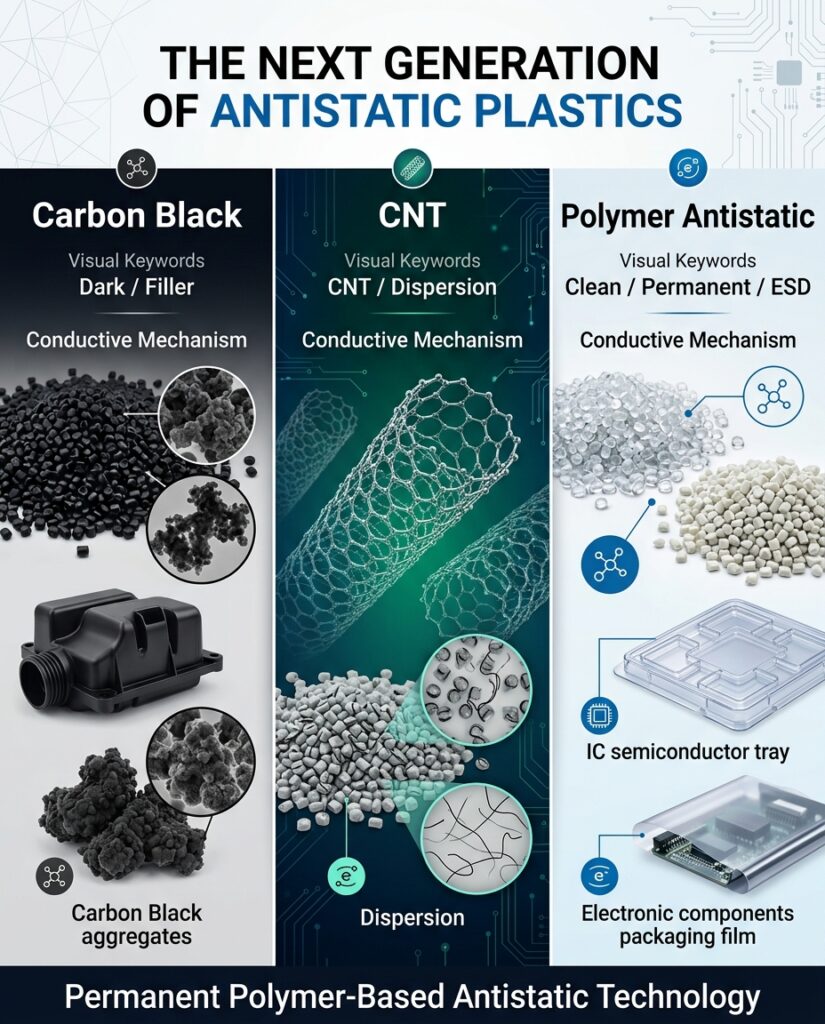
In plastic antistatic applications, carbon black, carbon nanotubes (CNTs), and surface coatings have been widely used for years. However, as semiconductor, electronics, optical and cleanroom applications demand higher cleanliness, stability and design flexibility, the limitations of traditional solutions are becoming more apparent.
## Why Are Traditional Antistatic Solutions Facing Challenges?
**Carbon black systems** are cost-effective and highly conductive, but they usually require relatively high loading and are limited to dark-colored products. They may also affect mechanical properties and surface cleanliness.
**CNT systems** can achieve conductivity at lower loading levels, but they require careful dispersion and processing control. Their higher material cost can also make large-scale production more challenging.
**Surface antistatic coatings** provide a relatively simple solution, but their performance can decrease after repeated wiping, washing, friction or long-term use.
## A New Approach: Permanent Polymer-Based Antistatic Technology
Polymer-based permanent antistatic additives work within the plastic matrix rather than relying on conductive fillers or temporary surface coatings.
This approach can offer several advantages:
* **Cleaner surfaces** with no carbon black or CNT filler particles
* **Greater design freedom**, including natural, colored and transparent products
* **Long-lasting antistatic performance**
* **Better retention of mechanical properties** at low addition levels
* **Compatibility with conventional injection molding and extrusion processes**
For applications such as semiconductor packaging, electronic components, cleanroom products and precision plastic parts, the focus is shifting from simply achieving antistatic performance to achieving **cleanliness, stability, appearance and long-term consistency**.
Polymer-based permanent antistatic technology provides a promising solution for the next generation of high-performance ESD plastics.