
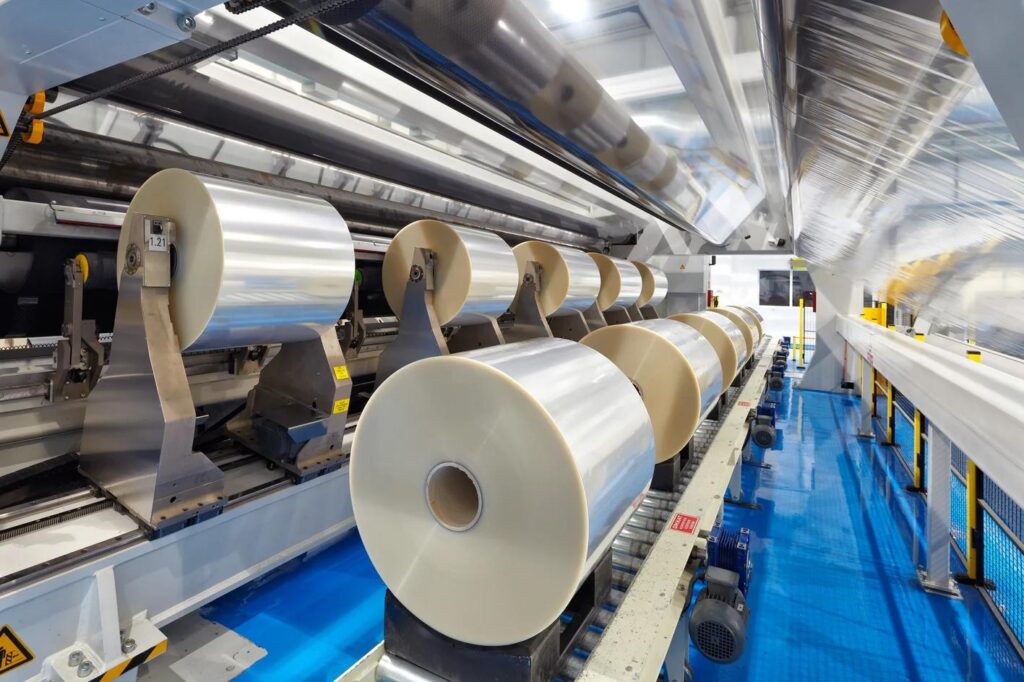
BOPP (Biaxially Oriented Polypropylene) and BOPET (Biaxially Oriented Polyethylene Terephthalate) are widely used in flexible packaging, electronic packaging, labeling, and industrial applications.Choosing the right antistatic solutions for BOPP and BOPET films requires careful consideration of resin compatibility, processing conditions, and the final film properties.
Although both materials are insulating polymers, their molecular structures, processing conditions, and surface characteristics are different. Therefore, selecting an appropriate antistatic solution requires a material-specific approach.
In this article, we explore the key differences between antistatic solutions for BOPP and BOPET films.
1.Understanding BOPP and BOPET Film Characteristics
Before selecting an antistatic additive, it is important to understand the characteristics of each material.
BOPP Film (Biaxially Oriented Polypropylene)
- Made from polypropylene (PP).
- Low surface energy and naturally hydrophobic.
- Widely used in food packaging, labels, tapes, and flexible packaging.
- Excellent moisture resistance and good transparency.
- Commonly processed through extrusion and biaxial orientation.
BOPET Film (Biaxially Oriented Polyethylene Terephthalate)
- Made from polyethylene terephthalate (PET).
- Higher surface energy than PP.
- Excellent mechanical strength, dimensional stability, and heat resistance.
- Widely used in electronic packaging, electrical insulation, high-performance packaging, and industrial films.
- Requires high-temperature processing and biaxial orientation.
These differences affect the compatibility, processing stability, and final performance of antistatic additives.For additional information on plastics and polymer materials, visit Plastics Europe.
2.Antistatic Requirements for BOPP and BOPET Films
Although both films need to control electrostatic accumulation, their application requirements may differ.
BOPP Films
BOPP films are commonly used in high-speed packaging and converting processes. Static electricity can cause:
- Dust attraction during production and packaging.
- Film sticking and feeding problems.
- Difficulties during slitting, winding, and unwinding.
- Reduced packaging efficiency.
For BOPP films, antistatic performance must be balanced with transparency, coefficient of friction (COF), sealing properties, and printability.
BOPET Films
BOPET films are often used in applications requiring higher mechanical strength, dimensional stability, and electrical performance.
Static electricity may lead to:
- Dust contamination.
- Film handling and winding problems.
- Electrostatic discharge (ESD) risks in sensitive applications.
- Processing difficulties in electronic and industrial packaging.
For BOPET films, antistatic solutions must also maintain optical clarity, thermal stability, and dimensional consistency.
3. Comparing Antistatic Solutions for BOPP and BOPET Films
There are several approaches to controlling static electricity in plastic films.
A. Conventional Migratory Antistatic Agents
Conventional migratory antistatic agents work by moving toward the film surface and forming a moisture-assisted conductive layer.
They can provide relatively quick antistatic effects, but their performance may be affected by humidity, aging, washing, and surface migration.
In certain applications, excessive migration may also affect film appearance, printing, lamination, or sealing performance.
B. Permanent Antistatic Additives
Permanent antistatic additives are designed to provide more stable antistatic performance through the polymer matrix rather than relying solely on surface migration.Explore BOMAN’s permanent antistatic additives for different plastic materials and applications.
For BOPP, the additive should have good compatibility with polypropylene and withstand extrusion and orientation conditions.For more information, explore our PP permanent antistatic additives.
For BOPET, the additive must meet the higher processing-temperature requirements of PET and maintain suitable dispersion, thermal stability, and film optical properties.
The selection of a suitable permanent antistatic additive should therefore be based on the specific resin, processing conditions, and end-use requirements.
C. Surface Antistatic Coatings
Antistatic coatings can also be applied to film surfaces.
They are useful when surface functionality is required, but coating adhesion, durability, coating uniformity, and compatibility with subsequent printing or lamination processes must be considered.
4. Key Factors for Selecting Antistatic Additives
Whether producing BOPP or BOPET films, several factors should be evaluated:
- Resin compatibility: The additive must be compatible with the base polymer.
- Processing temperature: Thermal stability is especially important for PET processing.
- Surface resistivity: The target should be determined according to the final application.
- Optical properties: Transparency, haze, and surface appearance should be maintained.
- Mechanical properties: Tensile strength, elongation, and film flexibility should not be negatively affected.
- Processing performance: COF, sealing, printing, lamination, winding, and slitting performance should be evaluated.
- Antistatic durability: Performance should be tested under different humidity conditions and after aging.
5.How to Choose the Right Antistatic Solution?
When comparing antistatic solutions for BOPP and BOPET films, manufacturers should consider not only antistatic performance but also film transparency, processing stability, and long-term reliability. There is no universal antistatic additive suitable for every BOPP and BOPET application.
For BOPP films, the focus is often on PP compatibility, processing stability, transparency, and high-speed packaging performance.
For BOPET films, the key considerations include PET compatibility, high-temperature resistance, optical properties, and dimensional stability.
The best solution should be selected through formulation evaluation and processing trials.
Conclusion
BOPP and BOPET films have different material characteristics and processing requirements. Consequently, their antistatic solutions should not be selected using the same criteria.
Understanding the polymer structure, processing conditions, and end-use requirements is essential for achieving reliable and consistent antistatic performance.
At BOMAN, we focus on permanent antistatic additives and conductive material solutions for plastic applications. We believe that the right formulation starts with understanding the material and the customer’s actual processing requirements.