
Introduction
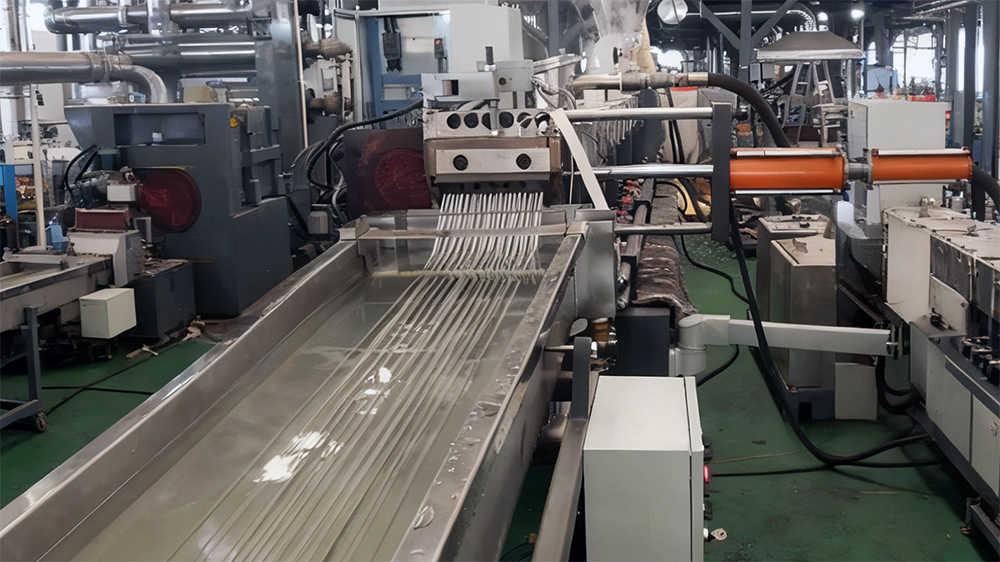
During discussions with customers, we frequently hear that achieving permanent antistatic performance in natural-color PC (polycarbonate) is more challenging than in natural-color ABS. Some customers have also reported difficulties during modification with domestically produced permanent antistatic masterbatches, including problems with strand extrusion and pelletizing.
Although PC and ABS are both widely used engineering plastics, they differ significantly in molecular structure, processing behavior, and compatibility with antistatic additives.
Compared with ABS, which generally offers a more forgiving processing window and relatively stable modification behavior, PC is more sensitive to moisture, processing conditions, thermal degradation, and additive compatibility. In natural-color systems, where pigments cannot be used to mask defects, maintaining appearance and product consistency becomes even more challenging.
These factors make natural-color PC permanent antistatic modification a demanding task for plastic compounders. The main challenges can be summarized in four areas.
1. PC Is More Sensitive to Moisture and Processing Conditions
One of the fundamental challenges in PC modification is its sensitivity to moisture and processing conditions.
PC contains polar carbonate groups in its molecular structure. When moisture is present during high-temperature melt processing, hydrolytic degradation can occur, reducing molecular weight and potentially affecting mechanical properties.
Insufficient drying or poor moisture control during extrusion may also contribute to appearance defects, including haze, yellowing, and surface imperfections. These issues are particularly noticeable in natural-color materials, where visual quality is a key requirement.
ABS generally has lower moisture sensitivity and is often easier to process in this respect, although appropriate drying and processing controls are still necessary.
PC also requires careful temperature management. Excessive processing temperatures or prolonged residence times can cause thermal degradation and discoloration. This creates an additional challenge when developing natural-color permanent antistatic compounds that must maintain both stable electrical performance and good appearance.
For compounders, effective moisture control, optimized drying conditions, and careful temperature management are essential starting points.
2. The Processing Window for PC Modification Can Be Narrower
Compared with many ABS formulations, natural-color PC permanent antistatic compounds may require tighter control over processing parameters.
Temperature, screw speed, feeding rate, residence time, and mixing efficiency can all influence additive dispersion and final product quality.
If the melt temperature is too high, PC may undergo thermal degradation and yellowing. If the temperature or mixing conditions are unsuitable, the antistatic additive may not disperse uniformly, potentially resulting in inconsistent electrical performance or visible defects.
Residual stress is another consideration. Improper extrusion, cooling, or pelletizing conditions can affect the dimensional stability and appearance of the resulting compound.
These challenges make it important to optimize the entire processing system rather than adjust temperature alone. Screw configuration, feeding strategy, mixing conditions, and cooling methods should be evaluated together.
For permanent antistatic modification, the objective is not simply to incorporate the additive into the resin. The formulation must also achieve consistent dispersion, stable electrical properties, and acceptable appearance under practical production conditions.
3. Natural-Color PC Makes Minor Defects More Visible
Natural-color materials offer no pigment-based masking effect. As a result, even minor processing or formulation defects can become apparent.
During PC modification, insufficient additive dispersion, incompatibility between formulation components, or unstable melt behavior may contribute to haze, flow marks, surface irregularities, or variations in gloss.
Scratches and handling marks can also affect the appearance of finished products, depending on the application and surface requirements.
ABS may offer a more forgiving processing experience in certain formulations because of its favorable flow and processing characteristics. However, the actual results depend on the resin grade, additive system, equipment, and processing conditions.
For natural-color PC permanent antistatic compounds, appearance control must therefore be considered alongside electrical performance.
A successful formulation needs to balance several requirements:
Uniform additive dispersion
Consistent surface appearance
Appropriate melt flow and processability
Stable antistatic performance
Acceptable color stability during processing and aging
Meeting all these requirements simultaneously is one of the main challenges in natural-color PC modification.
4. Permanent Antistatic Additives Require Careful Compatibility and Formulation
Permanent antistatic modification is not simply a matter of adding an antistatic agent to a resin. The additive must be compatible with the polymer matrix and processing conditions while delivering the required long-term electrical performance.
ABS and PC can respond differently to the same additive system. A formulation that performs well in ABS cannot automatically be transferred to PC without further evaluation.
In PC, additive compatibility, thermal stability, dispersion, and the effect on optical appearance all require careful consideration.
An insufficient additive loading may fail to achieve the target surface resistivity. An excessive loading or an unsuitable additive combination may affect transparency, gloss, mechanical properties, or processing behavior.
Color stability is another important consideration for natural-color PC. The resin grade, thermal history, stabilizer package, and antistatic formulation can all influence the final appearance. Yellowing resistance should therefore be evaluated through appropriate processing and aging tests rather than assumed from the formulation alone.
The best approach is to select an additive system specifically suited to the target resin and application, then optimize the dosage and processing conditions through systematic trials.
Conclusion: Successful PC Modification Requires More Than the Right Additive
In plastic compounding, natural-color PC permanent antistatic modification can present greater technical challenges than ABS because of its moisture sensitivity, processing requirements, appearance constraints, and formulation compatibility.
When customers report that a permanent antistatic masterbatch is difficult to process or that strands are difficult to form during extrusion, the problem should not automatically be attributed to the masterbatch alone.
Possible contributing factors include:
Inadequate resin or additive drying
Unsuitable processing temperatures or residence times
Poor feeding or melt-mixing conditions
Inadequate compatibility between the additive and resin
An unsuitable formulation or processing setup
A systematic assessment of the resin grade, additive formulation, processing conditions, and target performance is essential for identifying the actual cause.
For permanent antistatic PC applications, the real challenge is achieving a balance between processability, long-term antistatic performance, color stability, and appearance quality.
A formulation that works in ABS is only a starting reference—not a guarantee of success in PC.