
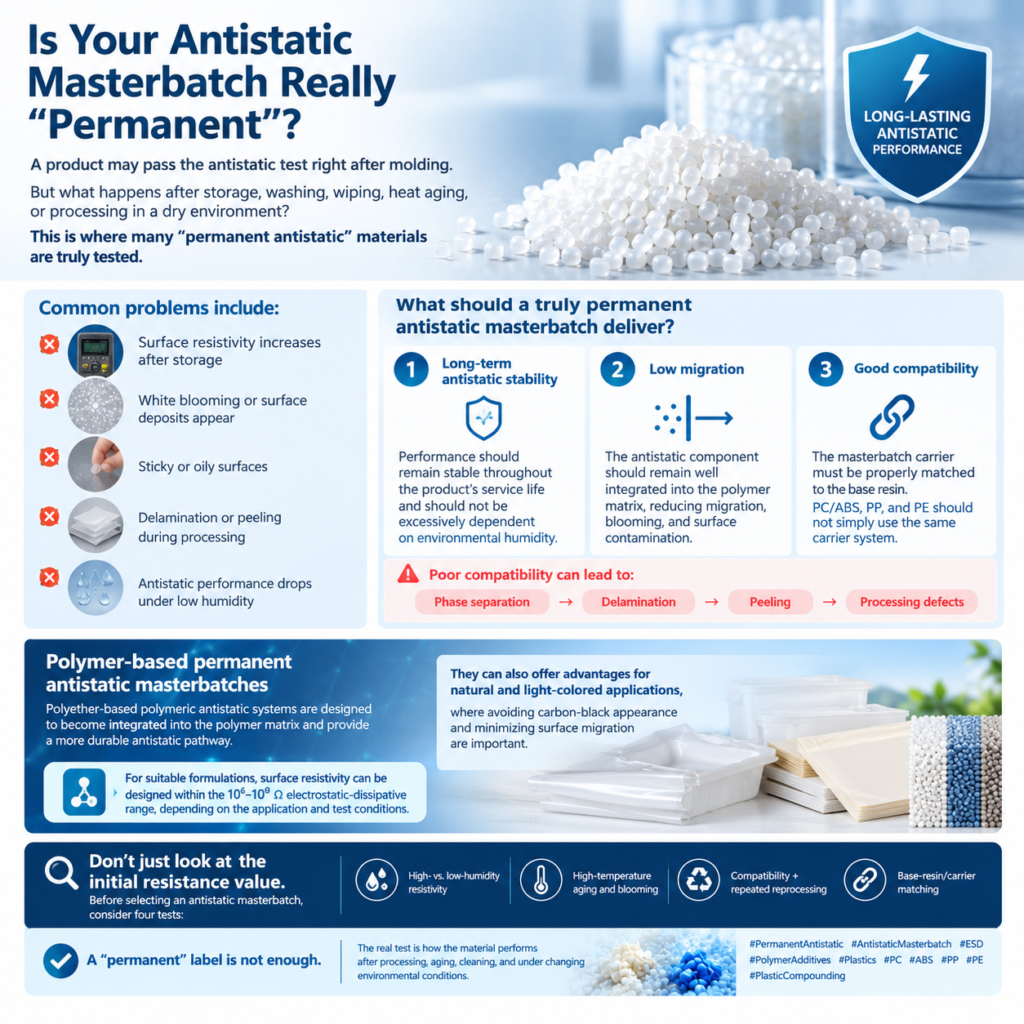
No Migration and No Phase Separation Are the Real Standards
The term “permanent antistatic masterbatch” is widely used in the market, but not every product marketed as permanent can deliver truly long-lasting performance.
Many compounders and plastic manufacturers encounter similar problems:
The finished product passes the resistivity test immediately after molding, but static performance deteriorates after storage.
The surface develops blooming or white deposits.
Injection molding or extrusion results in delamination or peeling.
Under low-temperature or dry conditions, the antistatic performance may drop significantly or even fail.
So, what should a truly permanent antistatic masterbatch deliver?
In applications such as electronic handling, new energy components, instrument housings, and antistatic sheets, antistatic performance can directly affect product quality, yield, and operational safety.
Beyond the Marketing Concept: What Is Truly Permanent Antistatic Performance?
Many low-cost antistatic products on the market use low-molecular-weight ionic antistatic systems.
Their working mechanism relies on the migration of small-molecule additives toward the product surface, where they interact with moisture in the air and form a conductive surface layer to help dissipate electrostatic charges.
This approach can be cost-effective and may pass short-term testing, but it has several inherent limitations.
1. Strong dependence on environmental humidity
Performance can be highly dependent on humidity.
Under low-humidity conditions, surface resistivity can increase significantly. Dry production areas, winter conditions, and low-humidity environments can therefore present challenges for moisture-dependent antistatic systems.
2. Migration and blooming
Because low-molecular-weight additives may have limited compatibility with the polymer matrix, they can gradually migrate toward the surface during long-term storage or exposure to heat.
This may result in blooming, whitening, or a sticky surface.
3. Loss of surface antistatic performance
Wiping and washing can affect the surface layer responsible for antistatic performance.
With repeated cleaning and surface wear, the antistatic effect may gradually decrease.
These systems may therefore be better described as short-term or conventional antistatic solutions, rather than permanent solutions for demanding industrial applications.
Three Core Requirements for True Permanent Antistatic Performance
A truly permanent antistatic solution should ideally meet three fundamental requirements:
1. Stable performance throughout the product’s service life
Antistatic performance should remain stable without excessive dependence on environmental humidity.
Performance should also be maintained after normal wear, wiping, and cleaning.
2. Antistatic components remain integrated within the polymer matrix
The conductive or antistatic component should remain stably incorporated within the polymer matrix, minimizing migration, blooming, and surface deposits.
This helps maintain a clean product surface.
3. Excellent compatibility with the base resin
The masterbatch should be properly matched with the target polymer.
Good compatibility helps reduce phase separation, delamination, and peeling during processing while maintaining the original mechanical properties of the base resin as much as possible.
The core principle is simple:
The antistatic function should be established within the material itself, rather than relying only on a temporary conductive layer on the surface.
Polymer-Based Permanent Antistatic Masterbatch: Addressing Migration and Delamination
Polyether-based polymeric permanent antistatic masterbatches are widely used for demanding applications.
Different formulations can be designed for PC, ABS, PC/ABS alloys, PP, and PE, with the carrier system matched to the target polymer.
This helps address two common industry problems: migration/blooming and phase separation.
1. Reducing Migration and Preventing Blooming
The fundamental cause of blooming is often poor compatibility between the antistatic component and the polymer matrix, particularly when low-molecular-weight materials continuously migrate toward the surface.
Polyether-based systems can use higher-molecular-weight polymeric antistatic components that remain more stably integrated within the polymer matrix, helping reduce the risk of migration and surface blooming.
After long-term aging tests at 85°C and repeated reprocessing and pelletizing evaluations, qualified polymer-based permanent antistatic samples can demonstrate good surface stability, without obvious oiling or white blooming.
This is important for applications where surface cleanliness and appearance are critical.
It can also help reduce the risk of contamination of precision components and minimize interference with subsequent processes such as printing, painting, and bonding.
2. Building Antistatic Performance Within the Material
Unlike low-molecular-weight additives that rely strongly on moisture-assisted surface conductivity, polymer-based permanent antistatic masterbatches are designed to establish an antistatic pathway within the polymer matrix.
The resulting structure allows electrostatic charges to be dissipated through the material rather than relying solely on moisture absorbed at the surface.
With proper formulation and processing, this can provide more stable surface resistivity under both high- and low-humidity conditions.
For specific formulations, surface resistivity can be designed to remain within the 10⁶–10⁹ Ω electrostatic-dissipative range, depending on the target application and test conditions.
Because the antistatic component is integrated into the material, normal wiping, washing, and surface wear are less likely to remove the entire antistatic function.
3. Polymer-Specific Carrier Systems Help Reduce Delamination
Delamination and peeling are common problems when an antistatic masterbatch is not properly matched to the base resin.
For example, using an ABS-compatible antistatic masterbatch directly in a PP or PE application may result in poor compatibility between the carrier resin and the base polymer.
After compounding, phase separation can occur, leading to problems such as:
Delamination
Peeling
Silver streaks
Poor dispersion
Surface defects
High-quality polymer-based permanent antistatic masterbatches should therefore be developed with polymer-specific carrier systems.
PC/ABS, PP, and PE should be formulated separately according to their individual processing and compatibility requirements.
A properly matched carrier can improve dispersion during injection molding, extrusion, and sheet processing, helping reduce phase separation, peeling, and crystalline or particulate defects.
It can also help preserve important properties of the base polymer, including impact strength and heat resistance.
Polyether-Based Polymer Permanent Antistatic Masterbatch
Preferred for Natural and Light-Colored Applications
Suitable for:
PC,ABS,PC/ABS alloys,PP,PE
Key Advantages
Suitable for natural and light-colored applications
Can achieve natural or lightly translucent appearance
No carbon-black appearance
Low sensitivity to humidity
Lower migation and blooming risk
Excellent compatibility with properly matched base resins
Typical Applications
Instrument housings
Antistatic sheets
Electronic handling containers
Electronic packaging components
Reference Addition Rate
15–25%, depending on the required surface resistivity and formulation.
Antistatic Masterbatch Selection Guide: Four Tests You Should Not Skip
Do not evaluate an antistatic masterbatch only by its surface resistivity under normal temperature and high-humidity conditions.
During material selection, we recommend evaluating the following four areas:
1. High- and low-humidity resistivity testing
Test surface resistivity under both 55% RH and 20% RH conditions.
The smaller the difference between the two conditions, the better the stability of the antistatic performance.
2. High-temperature aging and blooming test
Place molded samples in an oven for long-term high-temperature aging.
Check whether the surface develops:
Oil exudation
Whitening
Blooming
Surface deposits
3. Compatibility and reprocessing test
Prepare molded samples and inspect them for:
Delamination
Peeling
Silver streaks
Poor dispersion
Then reprocess the material through 2–3 additional pelletizing cycles and monitor both appearance and surface resistivity.
4. Match the masterbatch to the base polymer
An antistatic masterbatch designed for PC/ABS should not automatically be used in PP or PE.
Base-resin compatibility is critical.
Even a high-performance antistatic masterbatch can fail if the carrier system is not compatible with the target polymer.
Looking for a Permanent Antistatic Solution?
If you are working with PC, ABS, PP, PE, or TPU and need antistatic performance for natural or light-colored applications, we would be happy to discuss your requirements.
Our polymer-based permanent antistatic masterbatches are developed with a focus on cost-effective performance, compatibility, low migration, and long-term antistatic stability.
Choose the right material. Reduce static-related problems.