
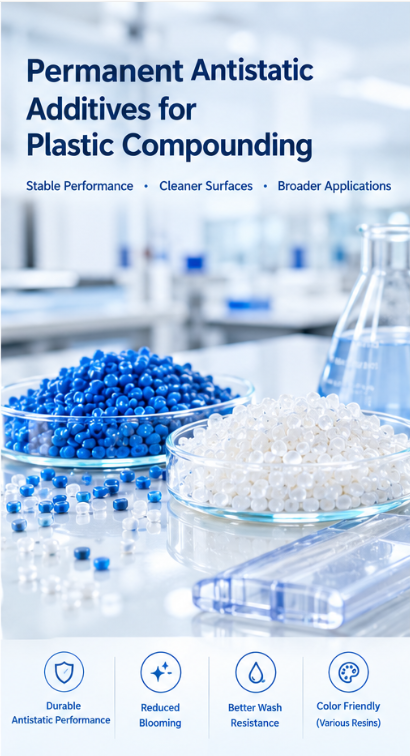
For experienced plastic compounders, small-molecule antistatic agents such as glycerol monostearate (GMS), fatty acid amides, and ethoxylated amines are familiar materials.
More than a decade ago, adding 3–5% of these additives could quickly reduce surface resistivity to approximately 10¹⁰ Ω in certain formulations. They offered a relatively low-cost way to achieve antistatic performance.
However, market expectations have changed. Complaints about surface blooming, white deposits, limited antistatic durability, and performance loss after washing are becoming increasingly important considerations.
Why are short-term antistatic systems facing these challenges, and when should compounders consider high-polymer permanent antistatic masterbatch?
1. Why Are Short-Term Antistatic Agents Becoming More Difficult to Use?
1.1 Their Working Mechanism Limits Their Service Life
Many conventional small-molecule antistatic agents work by migrating toward the plastic surface, where they attract moisture and help form a conductive surface layer.
This mechanism can provide rapid antistatic performance, but it also makes performance dependent on migration behavior, environmental conditions, and surface wear.
When the active molecules are removed through wiping or washing, or when their surface concentration changes over time, surface resistivity may increase and antistatic performance may deteriorate.
1.2 Three Common Problems in Plastic Compounding
Problem 1: Blooming and White Surface Deposits
When the dosage, compatibility, or storage conditions are unsuitable, small-molecule additives may accumulate on the surface and produce a white haze or visible deposits.
This can affect appearance-sensitive processes such as printing, bonding, coating, and electroplating.
Problem 2: Unstable Long-Term Performance
A molded product may meet the required surface-resistivity specification immediately after production. However, its performance may change during storage.
For example, surface resistivity may rise from around 10¹⁰ Ω to above 10¹² Ω after one or two months in a particular formulation. Actual results depend on the material system, environmental conditions, and test method.
This variation can make quality control and customer acceptance more difficult.
Problem 3: Limited Resistance to Wiping, Washing, and Heat
Repeated cleaning, surface abrasion, or heat exposure may reduce the effectiveness of conventional antistatic systems.
For reusable plastic components and products requiring long-term static control, this can become a significant limitation.
As expectations for surface cleanliness, durability, and regulatory compliance increase, compounders must evaluate more than initial antistatic performance. Applicable regulatory requirements should also be verified for each additive, application, and target market.
2. How Does High-Polymer Permanent Antistatic Masterbatch Work?
High-polymer permanent antistatic systems offer a different approach.
Typical materials include polyether ester amides (PEEA) and polyamide-polyether copolymers. Depending on their compatibility and morphology within the host resin, these polar polymers can form interconnected conductive pathways within the plastic material.
Unlike conventional systems that rely heavily on small-molecule migration and moisture adsorption at the surface, high-polymer antistatic systems can provide more durable antistatic performance through their polymer structure and distribution within the matrix.
2.1 Long-Lasting Antistatic Performance
Properly designed formulations can achieve a target surface resistivity range, often approximately 10⁸–10¹¹ Ω for antistatic applications.
Actual performance depends on the base resin, additive dosage, processing conditions, product geometry, conditioning, and measurement method.
Long-term stability should be verified through appropriate aging and application-specific testing.
2.2 Reduced Blooming and Cleaner Surfaces
Because performance does not rely primarily on the continuous migration of small molecules to the surface, compatible high-polymer systems can help reduce blooming and visible deposits.
This is particularly valuable for components requiring clean surfaces and consistent appearance.
However, compatibility and formulation still matter. Permanent antistatic additives should be evaluated in the actual resin and processing conditions.
2.3 Improved Durability After Wiping or Washing
For products exposed to repeated cleaning or handling, high-polymer permanent antistatic systems may provide better durability than conventional migratory additives.
The level of durability depends on the formulation and test conditions. Wiping, washing, heat aging, and other relevant stresses should be included in product validation.
2.4 Greater Flexibility in Product Appearance
Carbon black and other conductive fillers can provide effective electrical performance, but they may limit color options or affect mechanical properties at higher loading levels.
Certain high-polymer permanent antistatic formulations can support natural-color, translucent, or colored products without relying on carbon-black-based conductive systems.
The final appearance depends on the host resin, additive compatibility, concentration, and processing conditions.
2.5 Evaluating Total Cost Rather Than Additive Price Alone
High-polymer permanent antistatic masterbatch may have a higher unit price than conventional small-molecule additives.
However, the total cost of a formulation also includes rejected products, rework, quality inspections, customer complaints, and production interruptions.
For demanding applications, a more stable formulation may provide better overall value when evaluated across the product’s service life.
3. Short-Term or Permanent Antistatic: Which Is More Suitable?
Neither technology is universally suitable for every application.
Short-term antistatic agents may remain an economical option for cost-sensitive products with limited service-life requirements and less demanding appearance specifications.
High-polymer permanent antistatic solutions are worth evaluating when products require longer-lasting static control, cleaner surfaces, or greater resistance to repeated handling and cleaning.
Potential applications include:
-
Electronics packaging: Plastic components and packaging requiring reliable static control.
-
Automotive interiors: Plastic parts where surface appearance and long-term performance matter.
-
Home appliance housings: Components requiring consistent appearance and functional reliability.
-
Long-life industrial plastic parts: Products exposed to repeated handling or environmental stress.
The appropriate solution should always be selected according to the resin, processing method, target surface resistivity, mechanical requirements, and actual service conditions.
4. Comprehensive Technical Support for Permanent Antistatic Plastics
Selecting an antistatic additive is only one part of the process. Achieving stable performance in mass production requires the right material, formulation, processing conditions, and validation methods.
We provide technical support for permanent antistatic solutions across general-purpose plastics, engineering plastics, and selected high-performance polymers.
4.1 Precise Material Selection
We evaluate the customer’s application requirements, including:
-
Operating temperature and humidity
-
Required surface resistivity
-
Surface cleanliness and appearance
-
Natural-color or colored product requirements
-
Mechanical properties and processing conditions
Based on these requirements, we help identify a suitable resin system and antistatic approach.
4.2 Customized Formulation Development
Depending on the application, formulation options may include high-polymer permanent antistatic additives, carbon nanotubes, conductive carbon black, or combinations of different conductive systems.
The objective is to balance electrical performance, mechanical strength, appearance, surface quality, and processing stability.
For example, simply increasing conductive-filler loading may improve electrical performance but negatively affect impact strength, elongation, or appearance. Formulation development must consider these factors together.
4.3 Support From Material Selection to Mass Production
We aim to help customers reduce unnecessary trial-and-error through application assessment, formulation recommendations, and performance validation.
If you are facing static attraction, unstable surface resistivity, blooming, performance loss after washing, processing difficulties, or compliance challenges, we welcome a discussion about your material and application requirements.
Looking for a suitable permanent antistatic solution for PP, PE, ABS, PC, or other plastic systems?
Contact us to discuss your application and identify a potential solution.