
Plastic additive blooming is a common surface defect in plastic manufacturing. It may appear as white powder, crystalline deposits, or visible residue on plastic products. Poor additive compatibility, excessive loading, and migration can also contribute to exudation, tackiness, and other surface problems.
However, sometimes plastic products develop unexpected surface or structural problems after additives are introduced.
Common issues include:
- White or powdery deposits on the plastic surface (blooming).
- Additives migrating or separating from the polymer (exudation).
- A sticky or oily surface (tackiness).
- Visible separation between material layers (layer separation).
Why do these problems occur? Are they caused by the additive itself, the base resin, or processing conditions?
Understanding the underlying mechanisms is essential for selecting the right additive and achieving stable product quality.
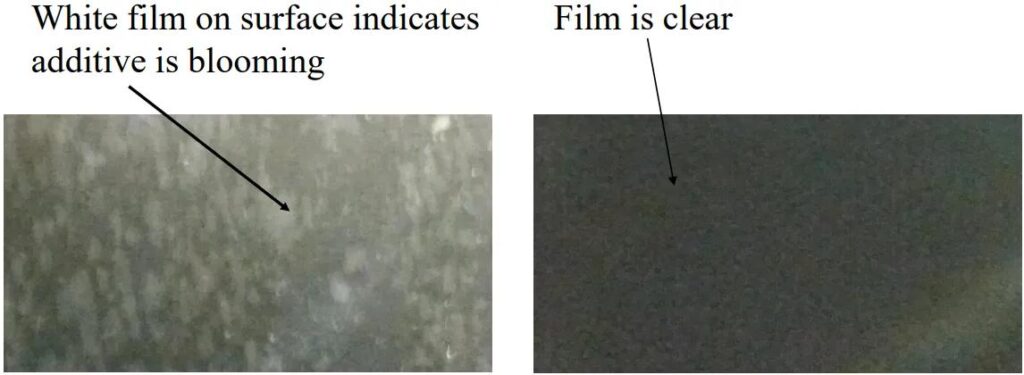
1. Blooming: Why Does a White Layer Appear on the Surface?
Blooming refers to the formation of a visible white, powdery, or crystalline layer on the surface of a plastic product.
It often occurs when certain low-molecular-weight additives gradually migrate from the interior of the polymer to its surface.
Common causes include:
- Poor compatibility between the additive and the base resin.
- Excessive additive loading beyond the compatibility limit.
- Changes in temperature during processing or storage.
- Additive migration over time.
- Chemical interactions between different formulation components.
For example, some conventional migratory antistatic agents work by moving toward the plastic surface and forming a moisture-attracting layer.Plastic additive blooming is often associated with poor compatibility between the additive and the polymer matrix. Selecting an appropriate additive and optimizing its loading level can help reduce this risk.
However, excessive migration or poor compatibility may result in visible deposits, uneven surface properties, or contamination risks.
How can it be reduced?
- Select additives with better compatibility with the target polymer.
- Optimize the additive concentration.
- Evaluate long-term surface stability.
- Consider non-migratory or permanent antistatic technologies when stable performance is required.
2. Exudation: Why Do Additives Separate from Plastic?
Exudation occurs when an additive gradually moves out of the polymer matrix and accumulates on the material surface.
Unlike simple surface contamination, exudation involves the separation or migration of formulation components from the polymer.
Possible causes include:
- Additive and polymer incompatibility.
- Excessive additive concentration.
- Low molecular weight or high mobility of certain additives.
- Changes in temperature and storage conditions.
- Interactions between multiple additives.
Plasticizers, lubricants, waxes, and some antistatic agents may contribute to this problem when the formulation is not properly balanced.
Exudation can affect surface appearance, printing, coating, bonding, and downstream processing.
How can it be reduced?
The first step is to identify which component is migrating.
Then, evaluate its compatibility, concentration, molecular characteristics, and behavior under actual processing and storage conditions.
Simply reducing the additive loading may help, but it does not always solve the underlying compatibility problem.
3. Tackiness: Why Does the Plastic Surface Become Sticky?
Tackiness refers to an undesirable sticky or oily feeling on the surface of a plastic product.
It may develop immediately after processing or gradually during storage.
Common causes include:
- Excessive plasticizer or lubricant content.
- Additive migration to the surface.
- Incomplete dispersion of additives.
- Incompatibility between the additive and polymer.
- Inappropriate processing temperatures.
- Residual low-molecular-weight components.
In some cases, an additive may be compatible at a certain concentration but become unstable when the loading increases.
Tackiness can cause dust attraction, handling difficulties, packaging problems, and reduced product appearance quality.
How can it be reduced?
- Review the complete formulation rather than focusing on one additive alone.
- Check the recommended loading range.
- Optimize mixing and dispersion.
- Verify processing temperatures and residence time.
- Conduct aging tests under realistic storage conditions.
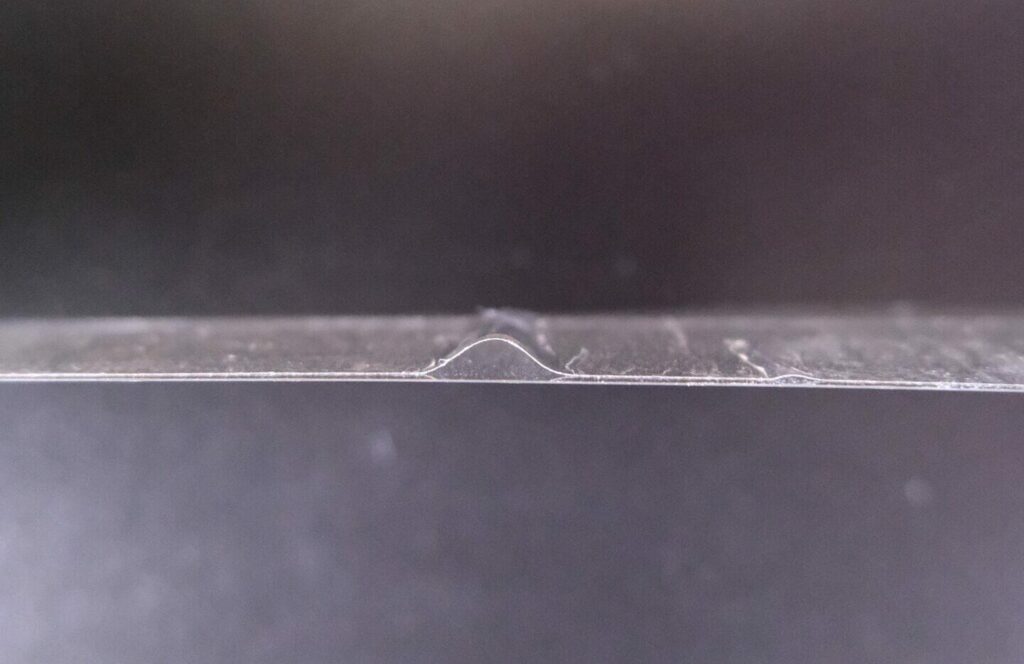
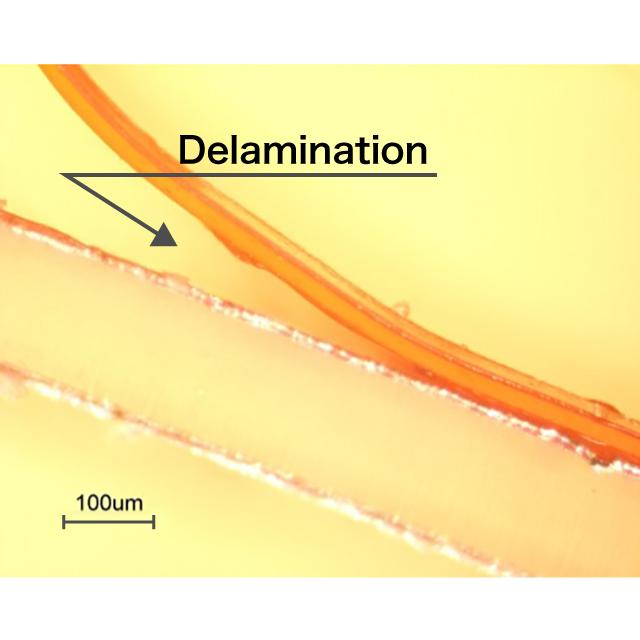
4. Layer Separation: Why Do Different Material Layers Fail to Bond?
Layer separation, also known as delamination, occurs when two polymer layers or material components lose adhesion.
It is particularly relevant in multilayer films, co-extruded products, laminated structures, and products made from different polymer systems.
Possible causes include:
- Poor compatibility between different polymers.
- Insufficient interfacial adhesion.
- Contamination on the material surface.
- Excessive lubricant or other migrating additives.
- Incorrect processing temperatures.
- Improper extrusion or lamination conditions.
For example, when a migrating additive accumulates at the interface between two layers, it may interfere with effective bonding.
However, not all delamination problems are caused by additives. Polymer selection, surface treatment, processing parameters, and adhesive systems must also be considered.
How can it be reduced?
- Check the compatibility of the polymer layers.
- Evaluate whether a suitable compatibilizer or tie layer is required.
- Control additive loading and migration.
- Optimize extrusion, lamination, and bonding conditions.
- Inspect the interface and identify the actual failure mechanism.
5. Why Is Additive Compatibility So Important?
An additive must do more than provide the desired function.
It must also work effectively within the target polymer system.
Three important factors should be considered:
1. Compatibility
The additive should have suitable compatibility with the base resin to maintain a stable polymer system.
2. Dispersion
Even a suitable additive may produce inconsistent results if it is not uniformly dispersed throughout the polymer.
3. Long-Term Stability
The additive should maintain its intended performance during processing, storage, and actual product use.
These factors are particularly important for antistatic additives, conductive materials, flame retardants, lubricants, and other functional additives.
6. How Does Permanent Antistatic Technology Help?
Traditional migratory antistatic agents often rely on movement toward the plastic surface to develop antistatic performance.
This mechanism can make their performance dependent on migration behavior, surface conditions, and environmental humidity.
Permanent antistatic additives use a different approach.
Certain polymer-based permanent antistatic technologies, such as PEEA-based systems, form conductive pathways within the polymer matrix rather than relying primarily on surface migration.
When properly selected and formulated, they can help provide:
- More stable antistatic performance.
- Reduced dependence on surface migration.
- Lower risk of blooming associated with migratory antistatic mechanisms.
- Better suitability for applications requiring long-term antistatic performance.
However, permanent antistatic additives are not automatically compatible with every polymer.
Their performance still depends on resin compatibility, loading level, dispersion, processing conditions, and the overall formulation.
Therefore, selecting the correct grade for PP, PE, ABS, PC, PA, or other polymers is essential.
7. What Should Manufacturers Check When These Problems Occur?
When blooming, exudation, tackiness, or layer separation appears, manufacturers should investigate the following factors:
| Inspection Area | Key Questions |
|---|---|
| Base resin | Is the polymer suitable for the selected additive? |
| Additive type | Is it migratory or non-migratory? |
| Loading level | Is the additive concentration appropriate? |
| Dispersion | Is the additive uniformly distributed? |
| Processing | Are temperature, mixing, and residence time appropriate? |
| Storage | Does the problem develop over time or under certain conditions? |
| Testing | Are surface appearance, resistivity, and adhesion evaluated after aging? |
A systematic investigation is more effective than simply changing the additive or adjusting the dosage without identifying the root cause.
For antistatic plastic applications, it is also important to evaluate electrical performance. Learn more about Surface Resistivity Testing and how to assess antistatic performance.For standardized electrical resistance measurements, manufacturers can also refer to the ASTM D257 standard, which covers DC resistance or conductance of insulating materials.
For applications requiring long-term antistatic stability, environmental testing is also important. Read our guide to the 85/85 Test for Antistatic Plastics to understand how temperature and humidity affect material performance.
Conclusion
Blooming, exudation, tackiness, and layer separation are not necessarily signs of poor additive quality alone.
They may result from additive incompatibility, excessive loading, migration, insufficient dispersion, or unsuitable processing conditions.
For plastic manufacturers, the key is to evaluate the complete formulation and understand how each component interacts with the polymer.
Choosing the right additive technology from the beginning can help reduce formulation risks and improve long-term product reliability.
Looking for a more stable antistatic solution for your plastic products?
BOMAN provides permanent antistatic additive solutions for different polymer systems, including PP, PE, ABS, PC, and other engineering plastics.
We also supply conductive carbon black and carbon nanotube (CNT) solutions for applications requiring conductive performance.
Contact BOMAN to discuss your material requirements and application challenges.