
Permanent antistatic additives vs. conductive carbon black is an important comparison in the plastics industry. Although both materials help control electrostatic problems, they work through different mechanisms and serve different electrical performance requirements.
Understanding these differences can help plastic manufacturers select the right additive for electronics packaging, semiconductor components, automotive plastics, and industrial plastic applications.
Two commonly used solutions are permanent antistatic additives and conductive carbon black.
Although both materials can improve the electrical properties of plastics, they work through different mechanisms and are designed for different performance requirements.
So, what is the difference between permanent antistatic additives and conductive carbon black? And how do you choose the right solution for your application?
Let’s take a closer look.
1. What Are Permanent Antistatic Additives?
Permanent antistatic additives are polymer-based functional additives designed to reduce static charge accumulation in plastic materials.
Unlike conventional low-molecular-weight antistatic agents, which migrate to the surface and rely heavily on environmental moisture, polymeric permanent antistatic additives provide a more stable and durable antistatic effect.
Many polymeric antistatic systems, such as polyether-based polymer additives, form a compatible dissipative phase within the plastic matrix.
This phase helps static charges dissipate, reducing dust attraction, electrostatic discharge risks, and other problems associated with static electricity.
Key Characteristics
- Permanent antistatic performance: Designed to provide long-term static dissipation.
- Low humidity sensitivity: Performance is generally less dependent on ambient humidity than conventional migrating antistatic agents.
- No carbon black required: Suitable for applications where maintaining the original material color is important.
- Good material compatibility: Properly selected grades can be used in different polymer systems, including PP, PE, ABS, PC, and PA.
- Balanced material properties: Designed to provide antistatic performance while maintaining the processability and mechanical properties of the base resin.
Depending on the formulation and application, permanent antistatic additives can achieve surface resistivity levels in the static-dissipative range, often around 10⁸–10¹² Ω/sq.
The actual result depends on the base resin, additive loading, dispersion, processing conditions, and testing environment.
2. What Is Conductive Carbon Black?
Conductive carbon black is a specially structured carbon material used to improve the electrical conductivity of plastics.
When properly dispersed in a polymer matrix at a sufficient concentration, carbon black particles come into contact or sufficiently close proximity to form an interconnected conductive network.
This phenomenon is known as the electrical percolation effect.
Once the conductive network is established, electrical charges can travel through the material more easily.
Unlike polymeric antistatic additives, conductive carbon black primarily provides conductivity through a network of conductive carbon particles.
Key Characteristics
- High electrical conductivity: Can achieve much lower surface resistivity than many antistatic systems.
- Stable conductive performance: The conductive network does not rely on environmental moisture or surface migration.
- Black coloration: Carbon black changes the color of the final plastic product.
- Loading and dispersion requirements: Electrical performance depends strongly on carbon black structure, concentration, and dispersion quality.
- Potential impact on material properties: High filler loading may affect melt flow, toughness, elongation, and other mechanical properties.
Depending on the carbon black grade, polymer matrix, and formulation, conductive carbon black compounds can achieve surface resistivity levels ranging from approximately 10³ to 10⁶ Ω/sq, or other levels according to the required application.
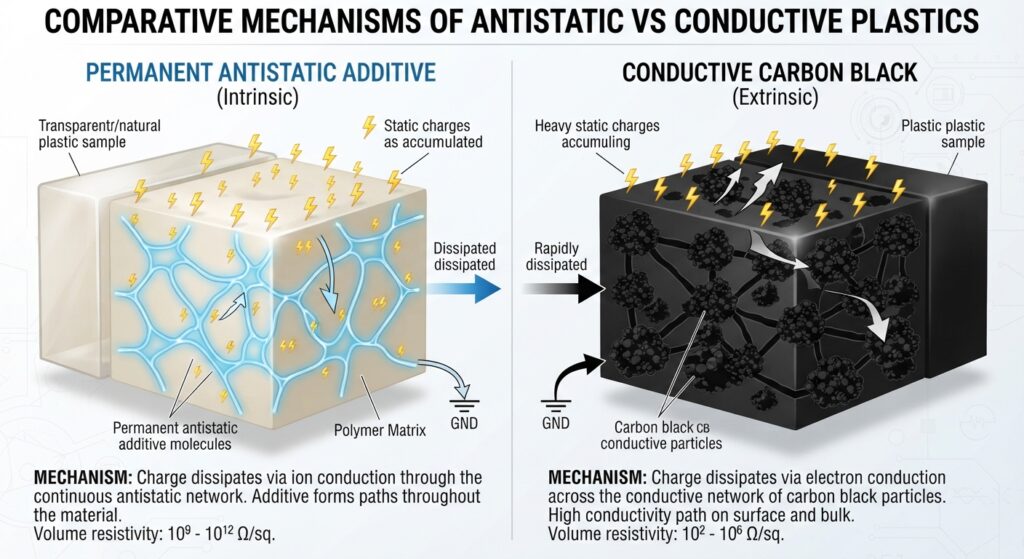
3. Permanent Antistatic Additives vs. Conductive Carbon Black
Although both materials help control electrostatic problems, their mechanisms and application objectives are different.
| Comparison | Permanent Antistatic Additives | Conductive Carbon Black |
|---|---|---|
| Main function | Static charge dissipation | Electrical conductivity |
| Working mechanism | Polymeric dissipative phase | Conductive carbon network |
| Typical surface resistivity | 10⁸–10¹² Ω/sq | 10³–10⁶ Ω/sq |
| Color impact | Usually maintains the base resin color | Produces black coloration |
| Humidity sensitivity | Generally low | Very low |
| Loading | Grade and resin dependent | Depends on percolation threshold |
| Mechanical properties | Designed to maintain a balance | May be affected by high filler loading |
| Typical applications | Antistatic packaging, plastic housings, electronic components | Conductive packaging, conductive plastic parts, ESD-related applications |
Note: The resistivity ranges above are indicative examples, not guaranteed specifications. Actual values depend on the material grade, formulation, processing conditions, specimen geometry, and test method.
Surface resistivity measurements should follow an appropriate test method, such as ASTM International standards, to ensure reliable and comparable results.
For accurate evaluation of antistatic plastics, it is important to understand the correct methods of surface resistivity testing.
4. Which One Should You Choose?
Choosing between permanent antistatic additives vs. conductive carbon black depends on the electrical performance requirements of the final plastic product.
The right choice depends on the electrical performance required by your final product.
Choose Permanent Antistatic Additives When:
- Your main objective is to prevent static charge accumulation.
- You need long-term antistatic performance.
- You want to maintain the original color of the plastic.
- You need to reduce dust attraction on plastic surfaces.
- Your application requires static-dissipative rather than highly conductive properties.
Typical applications include:
- Electronic component packaging
- Semiconductor plastic trays and containers
- Antistatic plastic housings
- Industrial plastic components
- Automotive plastic parts
Choose Conductive Carbon Black When:
- Your application requires higher electrical conductivity.
- You need a conductive pathway throughout the plastic material.
- Black coloration is acceptable.
- Your product requires conductive or low-resistance performance.
- You are manufacturing conductive plastic parts or packaging.
Typical applications include:
- Conductive plastic packaging
- Conductive trays and containers
- ESD-related plastic components
- Conductive automotive parts
- Industrial conductive plastic products
5. Is Permanent Antistatic Performance the Same as Electrical Conductivity?
No.
Antistatic performance and electrical conductivity are related, but they are not the same.
Antistatic materials are designed to reduce the accumulation of electrostatic charges by allowing them to dissipate.
Conductive materials provide a more effective pathway for electrical current to flow.
In practical plastic applications, the required electrical performance should be determined before selecting an additive.
For example, a plastic electronic component tray may only require reliable static dissipation. In this case, a permanent antistatic additive may be sufficient.
However, a conductive plastic container or component may require a much lower electrical resistance. Conductive carbon black may be a more appropriate solution.
Selecting an additive based only on the lowest achievable surface resistivity can lead to unnecessary costs or changes in material properties.
For applications requiring stable antistatic performance under different temperature and humidity conditions, the 85/85 test can provide useful information about material reliability.For electrostatic control applications, relevant guidance and standards published by the International Electrotechnical Commission (IEC) may also be useful.
6. Can Permanent Antistatic Additives and Conductive Carbon Black Be Used Together?
In some formulations, combining different functional additives may be technically possible.
However, it is not always necessary or beneficial.
The compatibility of the additives, their dispersion, the electrical performance target, and the processing conditions must all be evaluated.In addition, manufacturers should consider potential surface defects such as plastic additive blooming, which may affect the appearance and performance of plastic products.
For most applications, it is better to first identify the required surface resistivity or conductivity level, then select the most suitable additive system.
7. How to Select the Right Antistatic or Conductive Solution
Before choosing an additive, consider the following questions:
- What is the base resin: PP, PE, ABS, PC, PA, or another polymer?
- What surface resistivity or electrical conductivity is required?
- Does the final product need to retain its original color?
- Will the product operate under low-humidity conditions?
- What processing method will be used: injection molding, extrusion, or film production?
- What mechanical properties must be maintained?
These details help determine whether a permanent antistatic additive or conductive carbon black is the better choice.
For manufacturers comparing permanent antistatic additives vs. conductive carbon black, selecting the right solution starts with understanding the required electrical performance.
8. BOMAN: Permanent Antistatic and Conductive Material Solutions
At BOMAN, we focus on providing functional additive solutions for the plastics industry.
Our product range includes:
Permanent Antistatic Additives
Polymer-based antistatic solutions for different resin systems, including PP, PE, ABS, PC, and other engineering plastics.
Conductive Carbon Black
Conductive carbon black solutions available in powder and masterbatch forms for applications requiring improved electrical conductivity.
Carbon Nanotube (CNT) Solutions
CNT-based conductive materials for applications where conductive performance and material-property optimization are important.
We understand that different plastic applications have different electrical performance requirements.
Our goal is to help customers identify suitable materials based on their resin systems, processing methods, and target electrical properties.
Looking for the right solution for your plastic application?
Contact BOMAN to discuss your requirements for permanent antistatic additives, conductive carbon black, and other conductive materials.