
In plastic manufacturing, selecting the right permanent antistatic additive is only part of the solution. Antistatic additive loading also plays an important role in determining the final performance of the material.
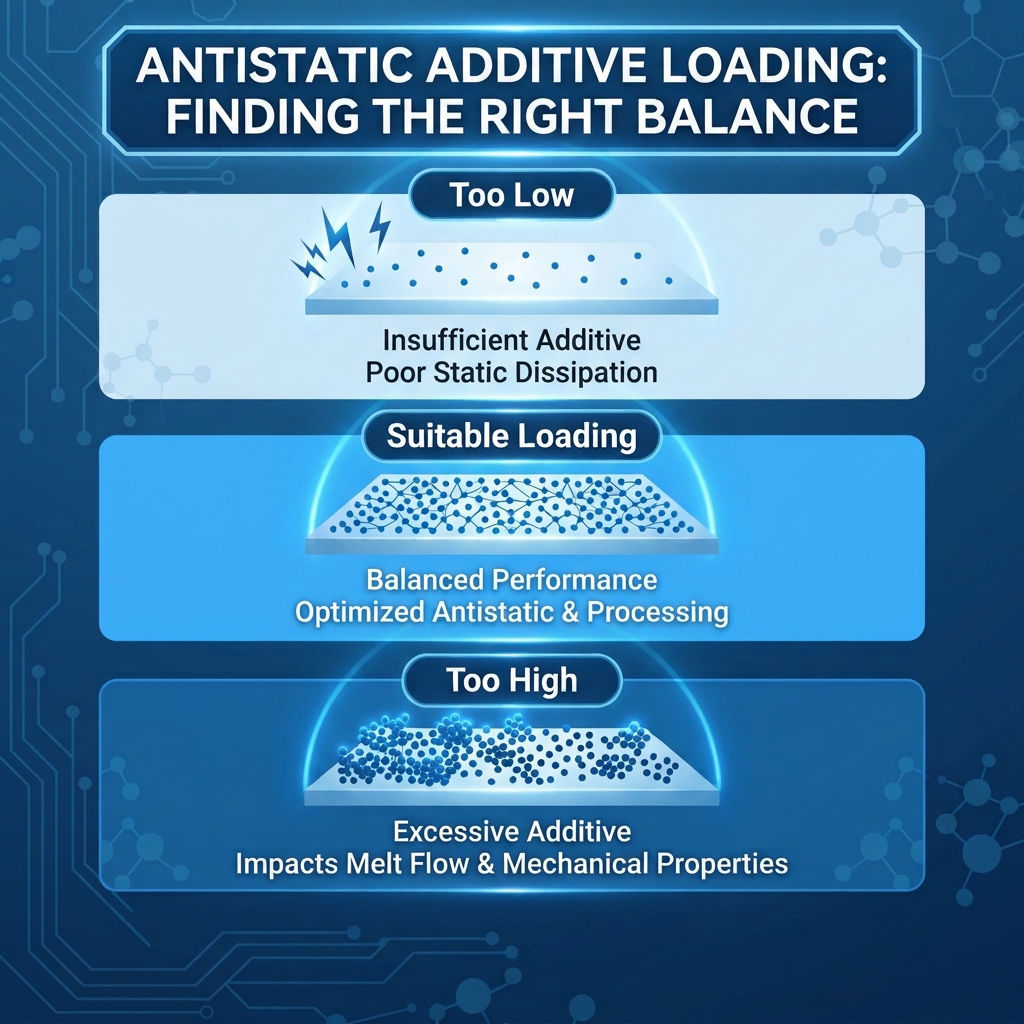
Too little additive may result in insufficient static dissipation, while excessive loading may affect melt flow, mechanical properties, surface quality, and processing stability.
So, why does additive loading influence both antistatic performance and processing properties? And how can manufacturers determine an appropriate loading level?
Let’s take a closer look.
1. How Does Additive Loading Affect Antistatic Performance?
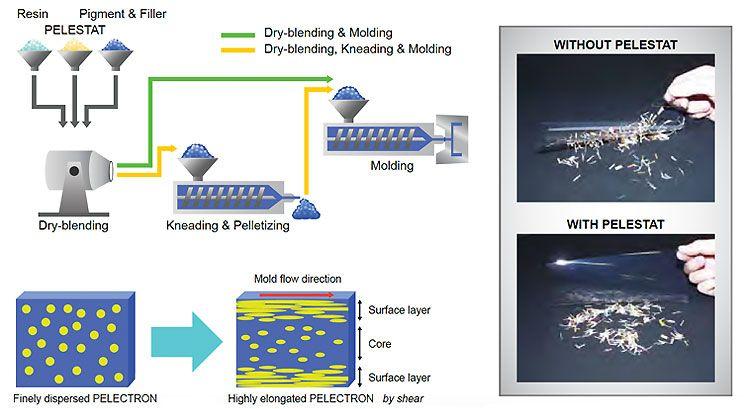
Permanent antistatic additives are designed to reduce static charge accumulation by creating a dissipative phase within the polymer matrix.
In many polymer-based systems, the antistatic component needs to be sufficiently distributed throughout the base resin to form effective charge-dissipation pathways.
When the additive loading is too low, these pathways may be insufficient or poorly connected. As a result, the material may not achieve the desired surface resistivity.
As the loading increases, the distribution of the antistatic component may become more effective, improving charge dissipation.
However, this improvement does not necessarily continue indefinitely. Once the formulation reaches a suitable performance level, adding more material may provide only limited additional benefits.
The key point: Antistatic performance depends not only on additive concentration, but also on compatibility, dispersion, resin structure, and processing conditions.Consistent surface resistivity testing is essential for comparing different additive loading levels and evaluating the final antistatic performance.
2. Why Can Too Little Additive Cause Insufficient Antistatic Performance?
When the additive concentration is below the suitable level, several problems may occur:
- Insufficient formation of a dissipative phase.
- Uneven distribution of the antistatic component.
- Surface resistivity higher than the target range.
- Inconsistent antistatic performance between batches.
- Reduced reliability under different temperature and humidity conditions.
The appropriate antistatic additive loading depends on the resin system, additive compatibility, and required electrical performance.
For example, a plastic packaging material may still attract dust or retain electrostatic charges if the additive loading is insufficient.
This is why manufacturers should evaluate the electrical performance of the finished product rather than relying only on the nominal additive percentage.
3. Why Can Excessive Additive Loading Affect Processing Properties?
Increasing additive loading may improve antistatic performance up to a certain point. However, excessive loading can also change the physical behavior of the polymer blend.
Depending on the additive type and base resin, high loading may cause:
Changes in melt flow
The additive may influence the viscosity and flow behavior of the molten material. This can affect injection filling, extrusion stability, and film formation.
Changes in mechanical properties
Excessive additive content may reduce tensile strength, stiffness, elongation, or impact performance, depending on the compatibility of the additive with the base resin.
Dispersion and surface problems
If the additive is not properly compatible or dispersed, it may contribute to surface defects, uneven appearance, or inconsistent material properties.
Higher formulation costs
Adding more additive than necessary increases material costs without necessarily delivering a meaningful improvement in antistatic performance.
Therefore, the highest possible loading is not always the best formulation.Excessive antistatic additive loading may increase formulation costs without providing significant additional performance benefits.Poor compatibility or dispersion may also contribute to plastic additive blooming, surface deposits, and other appearance problems.
4.Finding the Right Antistatic Additive Loading for Balanced Performance
The ideal loading level should provide the required electrical performance while maintaining acceptable processing and mechanical properties.
Manufacturers should consider several factors:
- Target surface resistivity: Define the electrical performance required by the application.
- Base resin: PP, PE, ABS, PC, and PA may require different additive formulations and loading levels.
- Compatibility: The additive should be suitable for the polymer matrix.
- Dispersion: Uniform distribution is essential for consistent performance.
- Processing method: Injection molding, extrusion, and film production may respond differently to the same formulation.
- Mechanical requirements: The finished product must retain the properties needed for its application.
A suitable formulation is therefore determined through testing, rather than by selecting the highest additive concentration.
5. Does Every Plastic Resin Require the Same Additive Loading?
No. Different polymers have different chemical structures, polarity, melt characteristics, and compatibility requirements.
For example:
- PP and PE: The additive must be compatible with the non-polar polyolefin matrix and the intended processing conditions.
- ABS and PC/ABS: Formulation selection should consider the resin blend, processing temperature, and required mechanical properties.
- PA6 and PA66: Moisture absorption and the properties of the polyamide matrix should be considered when evaluating antistatic performance.
- PC: Thermal stability and compatibility are important when selecting an additive for high-temperature processing.
Even within the same resin family, different grades and processing conditions may require different loading levels.
There is no universal addition ratio suitable for every plastic application.
6. How Should Manufacturers Determine the Appropriate Loading Level?
A practical formulation evaluation should include the following steps:
- Identify the base resin and final product application.
- Define the target surface resistivity or electrical performance.
- Start with the additive supplier’s recommended loading range.
- Prepare samples with different additive concentrations.
- Process the samples under representative production conditions.
- Measure surface resistivity using a consistent test method.
- Evaluate melt flow, mechanical properties, surface appearance, and processing stability.
- Select the formulation that provides the best balance of performance and cost.
For reliable electrical measurements, manufacturers should use appropriate test methods and refer to relevant guidance from ASTM International.
Evaluating different antistatic additive loading levels through practical trials helps manufacturers identify a suitable formulation.
Testing should be conducted under controlled conditions. Temperature, humidity, conditioning time, specimen preparation, and measurement methods can all influence the results.
7. Why Is the Recommended Loading Range Important?
The recommended loading range provided by an additive supplier is a useful starting point because it reflects the formulation characteristics and application experience of that particular product.
However, it should not be treated as a universal guarantee.
The final loading level may need to be adjusted according to:
- Resin grade and supplier.
- Additive compatibility.
- Processing equipment and conditions.
- Required electrical performance.
- Product geometry and end-use environment.
Manufacturers should verify the recommended range through trials using their own resin and production equipment.
8. BOMAN: Permanent Antistatic Solutions for Different Plastics
At BOMAN, we provide permanent antistatic additive solutions for different plastic materials and applications.
Our product range covers resin systems such as PP, PE, ABS, PC, and other engineering plastics.
We understand that different applications require different balances between antistatic performance, processing behavior, and mechanical properties.
Our approach is to help customers evaluate suitable additive grades and loading levels according to their resin systems, processing methods, and target electrical properties.
Looking for the right additive loading for your plastic application?
Contact BOMAN to discuss your resin, processing conditions, and antistatic performance requirements.
The right formulation starts with the right evaluation.