
Surface resistivity is one of the most important electrical properties used to evaluate antistatic and static-control plastics.
When selecting an antistatic additive, customers often specify a target value such as 10⁶ Ω, 10⁸ Ω or 10¹⁰ Ω.
But what do these numbers actually mean? Does a lower value always indicate better antistatic performance?
To understand this, we first need to look at what surface resistivity measures.
1. What Is Surface Resistivity?
Surface resistivity describes how strongly a material’s surface resists the movement of electrical charge.
In simple terms:
-
Lower resistance generally means electrical charge can move more easily across the surface.
-
Higher resistance means electrical charge has more difficulty moving across the surface.
For plastics, surface resistivity is commonly used to evaluate their ability to control or dissipate static electricity.
A technical note: Surface resistance and surface resistivity are not exactly the same. Surface resistance is measured in ohms (Ω), while surface resistivity is commonly expressed in ohms per square (Ω/sq or Ω/□). In commercial plastics data sheets, these terms and units are sometimes used inconsistently. Always check the test method and reporting convention before comparing values.
2. What Do Different Values Mean?
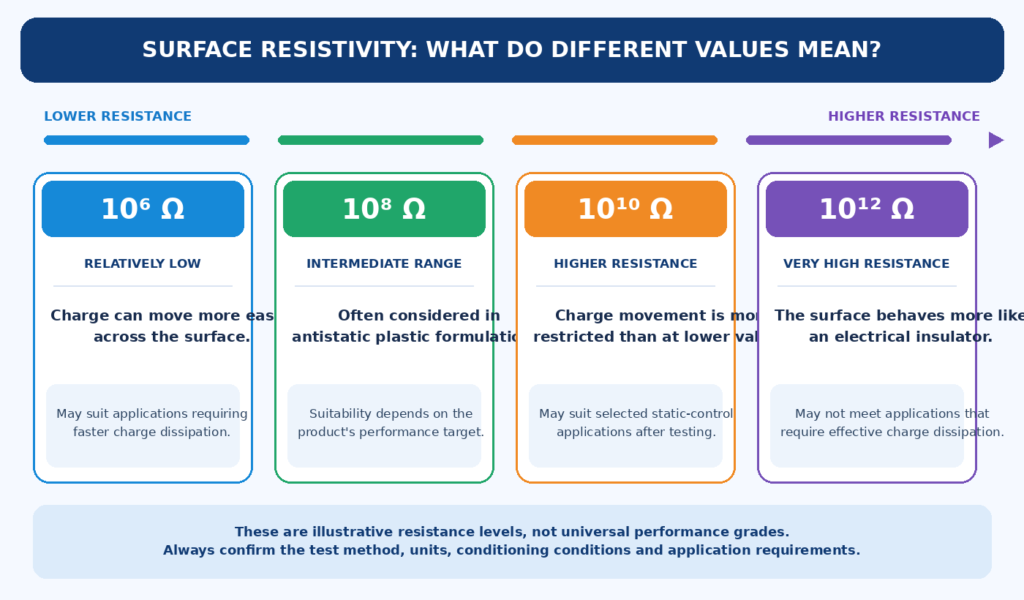
The following values provide a general way to understand how electrical resistance changes. They are illustrative reference points, not universal performance classifications.
10⁶ Ω – Relatively Low Resistance
A relatively low resistance allows charge to move more easily across the surface.
This type of performance may be required in applications where rapid charge dissipation or a more conductive surface is needed.
However, whether this value is suitable depends on the product’s electrical requirements and applicable standards.
10⁸ Ω – A Common Target in Antistatic Plastics
This range is often considered when developing antistatic plastic products.
It may provide a balance between static control and other material requirements, depending on the application.
For example, some plastic housings, trays and industrial components may require this type of electrical performance.
10¹⁰ Ω – Higher Resistance, with Static-Control Potential
At this level, the surface has greater resistance to charge movement than at 10⁶ or 10⁸ Ω.
It may still be suitable for certain static-control applications, but the actual charge-dissipation behavior should be verified through appropriate testing.
10¹² Ω – Very High Resistance
A value around this level indicates a highly resistive surface.
Such materials may behave more like electrical insulators and may not meet applications that require effective static dissipation.
However, the final judgment must always follow the customer’s specifications and the relevant test standard.
3. Is a Lower Surface Resistivity Always Better?
Not necessarily.
A lower value is not automatically the best choice for every plastic product.
The required electrical performance depends on:
-
The product’s end use
-
The level of static control required
-
The sensitivity of electronic components
-
The operating environment
-
Customer specifications and industry standards
For example, an electronic packaging tray, an industrial plastic component and a general-purpose plastic housing may have different electrical requirements.
The goal is not simply to achieve the lowest possible value. It is to achieve a suitable and stable level of static control.
4. What Affects Surface Resistivity?
The measured result can be influenced by several factors:
1. Resin type and formulation
Different plastics, such as PP, PE, ABS, PC, PA and PET, have different chemical structures and processing characteristics. An additive that works well in one resin may not deliver the same result in another.
2. Additive compatibility and dispersion
The compatibility and distribution of an antistatic additive within the polymer can affect the final electrical performance.
3. Temperature and humidity
Environmental conditions can influence the measured result, particularly for conventional moisture-dependent antistatic systems.
4. Processing conditions
Processing temperature, mixing quality, residence time and molding conditions may all affect the final product.
5. Testing method and sample preparation
Electrode design, applied voltage, conditioning time, temperature, humidity and sample preparation can influence test results.
Therefore, values obtained under different test conditions should not be compared directly.
5. How Should You Choose the Right Target?
Before selecting an antistatic additive, it is important to clarify:
-
What plastic resin is being used?
-
What is the final product and its application?
-
What surface resistivity or resistance range is required?
-
Which test standard and environmental conditions will be used?
-
Are there additional requirements for color, transparency, mechanical properties or processing?
A suitable formulation should meet the electrical target while maintaining the material’s overall performance.
Conclusion
Surface resistivity is an important indicator of static-control performance, but a single number does not tell the whole story.
Values such as 10⁶, 10⁸, 10¹⁰ and 10¹² Ω represent different levels of electrical resistance. Their suitability depends on the application, test method and customer requirements.
When developing antistatic plastics, the most important question is not simply:
“How low can the surface resistivity go?”
It is:
“What electrical performance does the application actually require, and can the material maintain it consistently?”
At Boman, we focus on permanent antistatic additive solutions for different plastic materials. If you are developing antistatic PP, PE, ABS, PC or other plastic products, feel free to contact us to discuss your material and performance requirements.