
Introduction
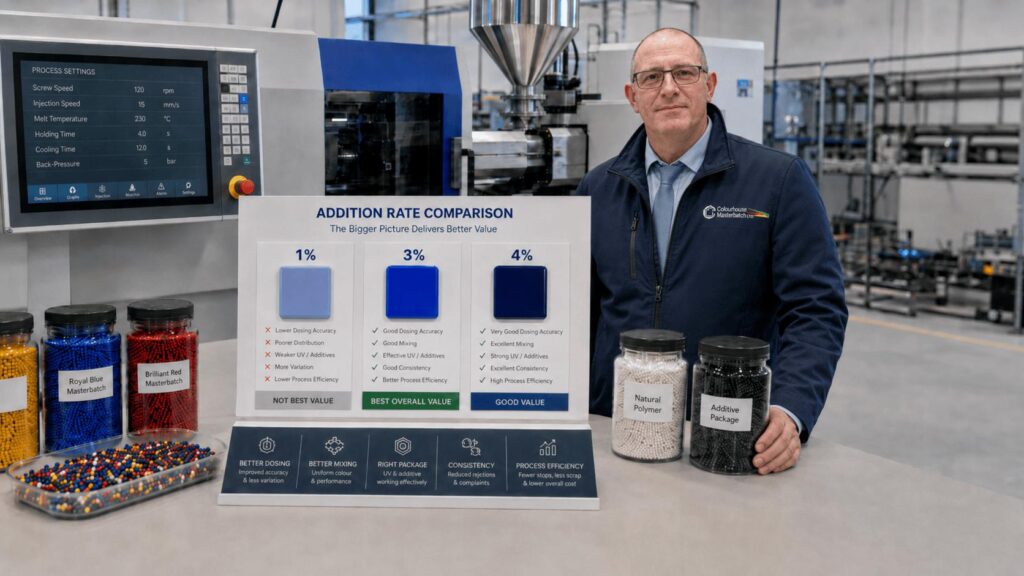
When developing antistatic plastics, choosing the right antistatic masterbatch is only part of the process. The antistatic masterbatch addition level also plays an important role in determining the final performance of the material.
Some manufacturers may find that a low addition level does not provide sufficient antistatic performance, while increasing the dosage improves the results.
But does adding more antistatic masterbatch always lead to better performance?
Not necessarily.
The final performance depends on several factors, including additive concentration, dispersion, compatibility with the polymer matrix, and processing conditions.
In this article, we explain why the addition level matters and how to determine a suitable dosage for antistatic plastic applications.
1. Why Does Antistatic Masterbatch Addition Level Matter?
Antistatic masterbatch contains active components designed to help dissipate electrostatic charges in plastic materials.
When the masterbatch is added to the base resin, the active components are distributed throughout the polymer matrix.
The addition level determines how much active antistatic material is introduced into the final formulation.
If the dosage is too low, the antistatic components may not be sufficient to establish an effective charge-dissipation mechanism.
As a result:
- Surface resistance may remain high.
- Static charges may accumulate more easily.
- Antistatic performance may not meet the application requirements.
An appropriate addition level helps the material achieve the required antistatic performance.
2. Does a Higher Addition Level Always Mean Better Performance?
Not necessarily.
Increasing the addition level may improve antistatic performance up to a certain point, but excessive addition does not always provide proportional benefits.
Depending on the additive system and polymer matrix, excessive dosage may lead to:
- Higher material costs.
- Changes in mechanical properties.
- Reduced processing stability.
- Changes in appearance or surface quality.
- Potential compatibility or dispersion problems.
For example, excessive addition may affect the stiffness, toughness, or flow behavior of the final plastic material.
Therefore, the goal is not to use the highest possible dosage, but to identify the optimal addition level that balances antistatic performance, processing, material properties, and cost.
3. Why Is Dispersion Important?
Even when the addition level is correct, poor dispersion can affect the final antistatic performance.
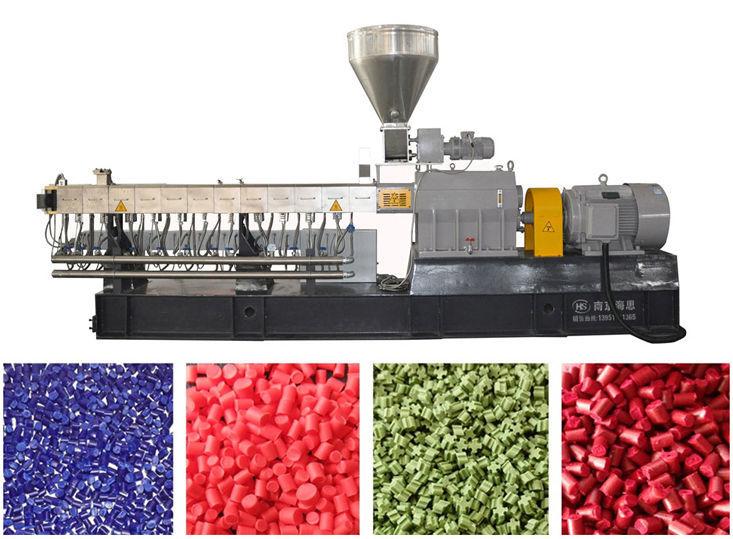
During compounding, the antistatic masterbatch needs to be distributed evenly throughout the base resin.
If dispersion is insufficient, the material may contain areas with different additive concentrations.
This can lead to inconsistent antistatic performance across the final product.
Good dispersion helps improve the consistency of the material and makes it easier to achieve the target electrical properties.
Processing conditions, screw design, mixing efficiency, and the compatibility between the masterbatch carrier and base resin can all influence dispersion.
4. Why Does Polymer Compatibility Matter?
The compatibility between the antistatic masterbatch carrier and the base polymer is another important factor.
Different plastics have different molecular structures and processing characteristics.
A masterbatch designed for PP may not provide the same performance when used in PE, ABS, PC, or other engineering plastics.
Poor compatibility may result in:
- Uneven additive distribution.
- Reduced mechanical properties.
- Surface defects.
- Unstable antistatic performance.
Therefore, the masterbatch should be selected according to the specific polymer and processing requirements.
5. How Can You Determine the Right Addition Level?
There is no single dosage suitable for every antistatic plastic application.
A practical approach is to conduct a dosage evaluation.
Step 1: Select the appropriate masterbatch
Choose a product compatible with the target polymer.
Step 2: Prepare samples with different addition levels
For example, test several dosage levels while keeping other formulation and processing conditions consistent.
Step 3: Measure surface resistance or surface resistivity
Use the same testing method and environmental conditions for all samples.
Step 4: Evaluate mechanical and processing properties
Check whether the material maintains the required mechanical properties, appearance, and processability.
Step 5: Select the most suitable dosage
Choose the addition level that meets the target antistatic performance while maintaining material quality and cost efficiency.
For standardized electrical testing methods, manufacturers can also refer to the relevant publications from ASTM International.
6. Why Should You Follow the Recommended Addition Level?
The recommended dosage provided by the additive supplier is usually based on specific formulation and processing conditions.
However, actual performance may vary depending on:
- Base polymer type.
- Masterbatch formulation and active content.
- Processing temperature and conditions.
- Product geometry and thickness.
- Required surface resistance.
- Testing temperature and humidity.
For this reason, the recommended dosage should be treated as a starting point for formulation development rather than a universal value.
For example, some polymer-based permanent antistatic additive systems may require different addition levels depending on whether they are used in PP, PE, ABS, or PC.
Conclusion
The antistatic masterbatch addition level is an important factor affecting the final antistatic performance of plastic materials.
Too little additive may result in insufficient charge dissipation, while excessive addition may increase costs or affect other material properties.
At the same time, good dispersion, polymer compatibility, and appropriate processing conditions are essential for achieving consistent results.
The key is to find the right balance between antistatic performance, material properties, processing stability, and cost.
At BOMAN, we focus on polymer-based permanent antistatic additives for plastics.
We believe that selecting the right additive and optimizing the formulation are both essential to achieving reliable antistatic performance.
Looking for a suitable permanent antistatic solution for your plastic application? Contact BOMAN to discuss your requirements.