Introduction
Polyamide (PA), commonly known as nylon, is widely used in engineering plastics, electrical components, automotive parts, industrial equipment, and electronic applications.
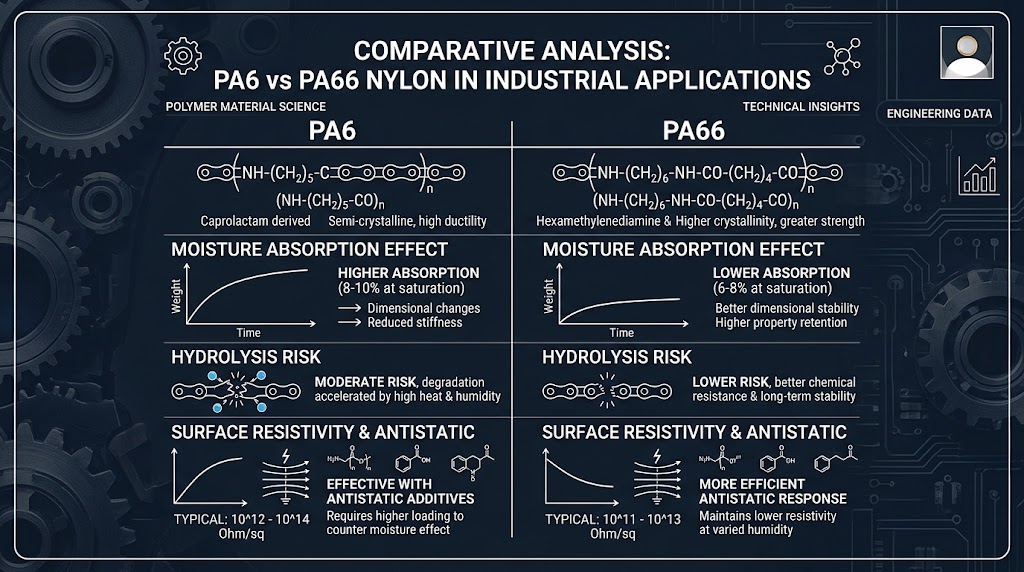
Two common grades are PA6 and PA66. Both offer useful mechanical properties, but they differ in their molecular structure, melting behavior, processing requirements, and moisture absorption characteristics.
When developing an antistatic formulation for nylon, these differences matter. Moisture can influence the properties of the nylon itself, while environmental humidity may also affect the performance of certain antistatic technologies.
Understanding the relationship between PA6, PA66, moisture, and antistatic additives is therefore essential for selecting a suitable solution.
1. What Is the Difference Between PA6 and PA66?
PA6 and PA66 are both engineering polyamides, but they are produced from different monomers and have different molecular structures.
PA6
PA6 is produced from caprolactam.
It is widely used in injection-molded components, electrical parts, automotive applications, films, and industrial products.
Depending on the grade and formulation, PA6 can offer good toughness, wear resistance, and processing versatility.
PA66
PA66 is produced from hexamethylenediamine and adipic acid.
Compared with many PA6 grades, PA66 generally has a higher melting point and may offer advantages in stiffness, strength, and performance at elevated temperatures.
However, the actual properties of both materials depend on the grade, reinforcement, additives, moisture condition, and processing history.
Why Does This Difference Matter for Antistatic Modification?
An additive that performs well in PA6 should not automatically be assumed to deliver the same results in PA66.
The two materials may require different processing conditions, and the compatibility and dispersion of an antistatic additive may differ between formulations.
When selecting an additive, consider the exact nylon grade rather than treating all PA materials as interchangeable.
2. Why Does Moisture Matter in Nylon?
Unlike many common polyolefins, such as PP and PE, nylon absorbs moisture from its surrounding environment.
This happens because polyamide contains polar amide groups that interact with water molecules.
Moisture absorption can influence several properties of nylon, including:
- Dimensional stability
- Stiffness and tensile behavior
- Toughness and elongation
- Processing behavior
- Electrical properties
The extent of these changes depends on the PA grade, temperature, relative humidity, exposure time, and material formulation.
For processing, moisture must also be controlled carefully. Excessive moisture in the melt can cause hydrolytic degradation and reduce the molecular weight of the polymer.
Therefore, two separate issues must be considered: moisture absorbed by the finished material during use, and moisture present in the resin before melt processing.
3. How Can Humidity Affect Antistatic Performance?
The effect of humidity depends strongly on the antistatic technology being used.
3.1 Conventional Migratory Antistatic Agents
Many conventional antistatic agents work by migrating toward the polymer surface, where they help reduce the buildup of electrostatic charge.
For some formulations, absorbed moisture on or near the surface contributes to charge dissipation.
Under low-humidity conditions, the surface may retain less moisture, potentially reducing the effectiveness of these systems.
Their performance may also change with storage time, surface migration, washing, and formulation.
However, not all conventional antistatic agents behave identically. Their humidity dependence must be evaluated for the specific chemistry and application.
3.2 Polymeric Permanent Antistatic Materials
Polymeric antistatic materials, including certain polyether-amide or polyether-ester-amide systems, may provide a different approach to static control.
Their performance depends on the additive’s chemical structure, distribution within the polymer matrix, compatibility, formulation, and processing conditions.
Some polymeric antistatic systems can provide more stable performance across varying humidity conditions than conventional migratory agents, but this should not be assumed for every product.
For nylon applications, the compatibility of the antistatic additive with the selected PA grade is particularly important.
3.3 Moisture Absorption Is Not the Same as Antistatic Performance
Nylon’s moisture absorption and an additive’s antistatic mechanism should not be confused.
Although absorbed water can affect electrical behavior, moisture may also change mechanical properties and dimensions.
A nylon part that shows lower surface resistance after conditioning at higher humidity does not necessarily have a permanently antistatic formulation.
To understand the actual performance, electrical testing must be carried out under defined conditioning conditions.
4. Why Can Antistatic Modification of PA Be Challenging?
4.1 Compatibility and Dispersion
The additive must be compatible with the selected PA grade and adequately distributed throughout the formulation.
Poor compatibility or dispersion may lead to inconsistent electrical performance, changes in mechanical properties, or surface defects.
4.2 Processing Temperature
PA6 and PA66 have different melting and processing characteristics.
The additive must withstand the thermal conditions of the actual compounding and molding process without unacceptable degradation or discoloration.
The required thermal stability depends on the specific grade and process, rather than on the PA family name alone.
4.3 Moisture Control During Processing
Nylon resin generally needs to be dried according to the resin supplier’s recommendations before melt processing.
If the resin contains excessive moisture, hydrolytic degradation may affect melt viscosity, molecular weight, and final mechanical properties.
This can complicate the evaluation of an antistatic formulation because poor processing results may be mistakenly attributed to the additive.
4.4 Mechanical Properties
Nylon is often selected for applications that require strength, toughness, wear resistance, or dimensional stability.
Adding an antistatic material may change stiffness, impact performance, tensile properties, or other characteristics.
These effects depend on additive chemistry, concentration, compatibility, and the overall formulation.
4.5 Electrical Performance Under Different Conditions
A formulation may show different surface resistivity values at different temperatures, humidity levels, or conditioning times.
The customer’s electrical requirements should therefore be evaluated using a clearly defined test method and relevant environmental conditions.
5. How Should You Select an Antistatic Additive for PA6 or PA66?
Before selecting a product, confirm the following information.
1. Exact PA grade
Is the material PA6 or PA66? Is it unreinforced, glass-fiber-reinforced, impact-modified, or already compounded?
2. Processing method
Is the material injection molded, extruded, or processed using another method?
3. Electrical target
What surface resistivity, charge-decay performance, or other electrical specification is required?
4. Test conditions
What test method, temperature, relative humidity, and conditioning time will be used to evaluate the material?
5. Mechanical requirements
What impact strength, stiffness, tensile performance, or other properties must be maintained?
6. Processing conditions
Confirm the recommended drying conditions, melt temperature, residence time, and other relevant processing parameters.
7. End-use environment
Will the product operate under low humidity, high humidity, elevated temperatures, or changing environmental conditions?
8. Durability and compliance
Does the application require long-term antistatic performance, low surface deposits, or specific regulatory compliance?
These details help establish whether an additive is technically suitable and what validation tests are required.
6. How Should Antistatic PA Be Tested?
A reliable evaluation should include electrical, mechanical, and processing performance.
Electrical Testing
Measure surface resistivity or other relevant electrical properties using a defined method.
Where humidity may affect the result, test specimens should be conditioned at specified temperature and relative humidity for a defined period.
If the application requires charge-dissipation performance, additional charge-decay testing may be appropriate.
Moisture Conditioning
Where relevant, compare samples conditioned under different humidity environments.
This helps distinguish the effects of moisture conditioning from the effects of the antistatic additive itself.
Mechanical Testing
Check the mechanical properties important to the application, such as impact strength, tensile performance, stiffness, and dimensional stability.
Processing Evaluation
Observe compounding and molding stability, melt behavior, surface appearance, and finished-part consistency.
Durability Testing
If long-term performance is required, evaluate the material after representative storage, aging, or environmental exposure.
Testing conditions should reflect the intended application and customer specification.
Conclusion
PA6 and PA66 share the characteristics of engineering polyamides, but their melting behavior, processing requirements, and formulation responses are not identical.
Moisture adds another layer of complexity. It can influence nylon’s mechanical and electrical properties, while humidity may also affect certain antistatic technologies.
For this reason, selecting an antistatic additive for nylon requires more than identifying the polymer type. The exact PA grade, processing conditions, electrical target, moisture conditions, and mechanical requirements must all be considered.
The key principle is simple: evaluate the antistatic additive and the nylon formulation together, under clearly defined conditions.