
Antistatic additives play an important role in reducing electrostatic charge accumulation in plastic materials. They are widely used in electronic packaging, industrial plastic components, automotive plastics, and other applications where static control is required.
However, not all antistatic additives work in the same way.
One important difference is their molecular structure. Conventional low-molecular-weight antistatic agents and polymeric antistatic agents have different characteristics in terms of migration, compatibility, durability, and long-term performance.
So, what are the differences, and which type is more suitable for your plastic application?
1. What Are Low-Molecular-Weight Antistatic Agents?
Low-molecular-weight antistatic agents are generally small organic molecules, often based on surfactant-type compounds.
Common examples include:
- Fatty acid esters
- Ethoxylated amines
- Alkyl sulfonates
- Quaternary ammonium compounds
These additives are commonly used in plastics because they can provide antistatic effects at relatively low addition levels.
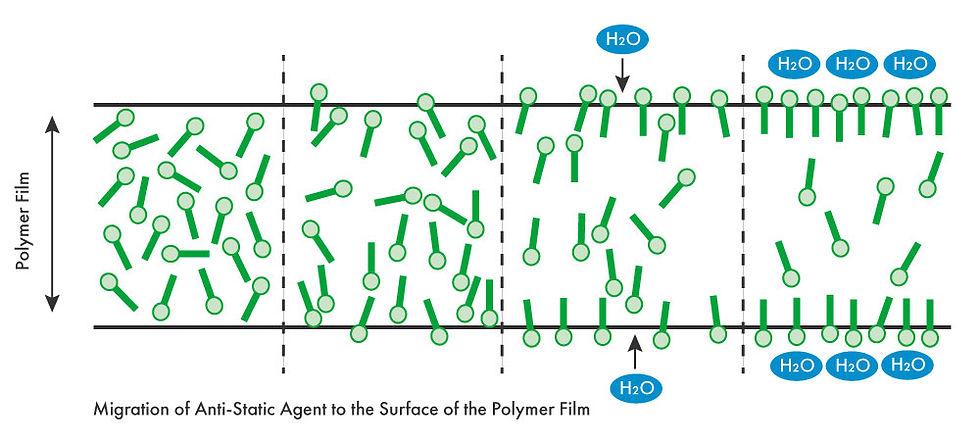
After being incorporated into a polymer, conventional migratory antistatic agents gradually move toward the material surface.
Their hydrophilic groups attract moisture from the surrounding environment, helping form a thin conductive layer that facilitates electrostatic charge dissipation.
However, their performance can be affected by humidity, washing, surface wear, and additive migration.
2. What Are Polymeric Antistatic Agents?
Polymeric antistatic agents are based on higher-molecular-weight polymer structures.
Typical examples include:
- Polyether ester amides (PEEA)
- Polyether block copolymers
- Certain polyether-based antistatic polymers
- Other functional polymeric antistatic systems
Unlike conventional small-molecule additives, polymeric antistatic agents have larger molecular structures and generally lower molecular mobility.
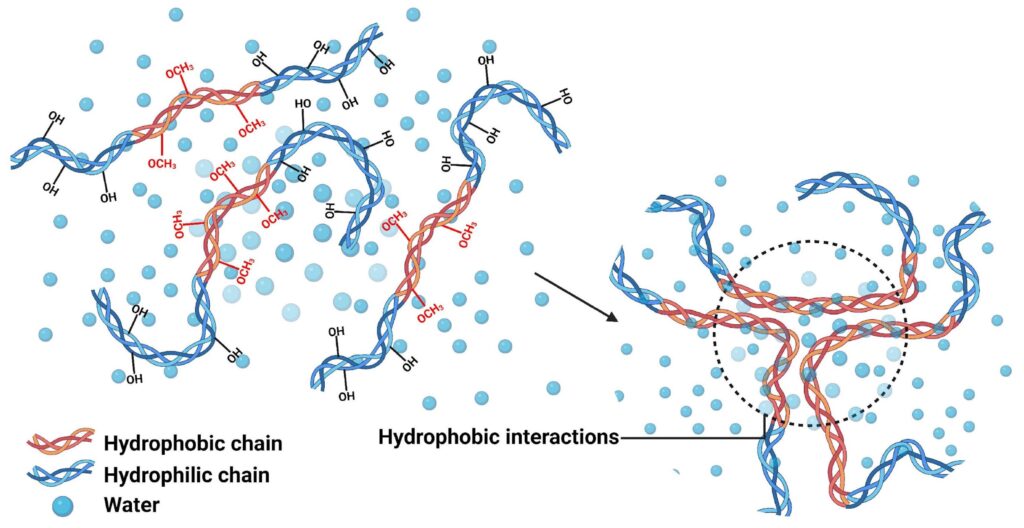
Some polymeric antistatic systems can form interconnected hydrophilic domains or charge-dissipation pathways within the polymer matrix.
This can help provide more consistent antistatic performance and reduce the tendency toward uncontrolled surface migration.
Their effectiveness still depends on compatibility with the base resin, formulation, processing conditions, and the final application.
3. Five Key Differences Between the Two Types
Difference 1: Molecular Structure
Low-molecular-weight antistatic agents consist of relatively small molecules.
Polymeric antistatic agents contain larger molecular chains or polymer structures.
This structural difference influences their mobility and behavior inside the plastic matrix.
Difference 2: Migration Behavior
Conventional low-molecular-weight antistatic agents often rely on migration toward the plastic surface to develop their antistatic effect.
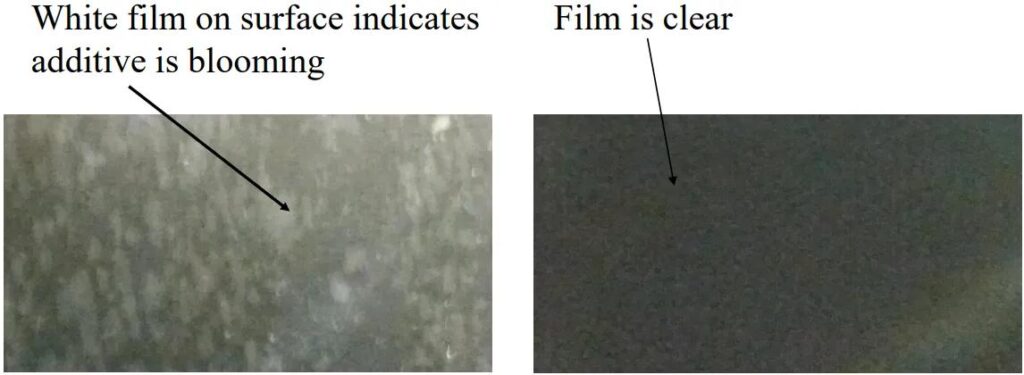
Excessive migration may lead to surface blooming, oily deposits, or additive loss.
Polymeric antistatic agents generally have lower molecular mobility, which can reduce uncontrolled migration and surface accumulation.
Difference 3: Long-Term Durability
The effectiveness of conventional migratory antistatic agents may decrease due to washing, wiping, aging, or changes in environmental humidity.
Polymeric antistatic systems are generally designed to provide better performance retention and more durable antistatic properties.
However, actual durability must be verified through application-specific testing.
Difference 4: Environmental Sensitivity
Many conventional migratory antistatic agents depend on moisture adsorption at the material surface.
Therefore, their performance can be significantly affected by relative humidity.
Some polymeric antistatic systems can provide more stable charge-dissipation pathways, although humidity may still influence their electrical properties.
Difference 5: Application Requirements
Low-molecular-weight antistatic agents may be suitable for applications where economical, short-term antistatic protection is sufficient.
Polymeric antistatic agents are often considered for applications requiring improved durability, reduced migration, and more consistent antistatic performance.
The appropriate choice depends on the resin, processing method, target surface resistivity, and service environment.
4. Comparison: Low-Molecular-Weight vs. Polymeric Antistatic Agents
| Property | Low-Molecular-Weight Agents | Polymeric Antistatic Agents |
|---|---|---|
| Molecular structure | Small molecules | Larger polymer structures |
| Molecular mobility | Generally higher | Generally lower |
| Migration tendency | Often higher | Generally lower |
| Surface blooming risk | Can be higher | Can be reduced |
| Long-term performance | May be affected by additive loss | Often better performance retention |
| Humidity sensitivity | Often significant | Depends on the polymer system |
| Typical examples | Fatty acid esters, amines, ammonium salts | PEEA and other functional polymers |
This comparison describes general tendencies rather than universal rules. Individual formulations may behave differently.
5. Why Are PEEA-Based Antistatic Additives Worth Considering?
Polyether ester amide (PEEA) is one important type of polymeric antistatic material.
Its polymer structure combines hydrophobic and hydrophilic segments.
The hydrophobic segments can help improve compatibility with suitable polymer matrices, while the hydrophilic segments contribute to charge dissipation.
When properly formulated and dispersed, PEEA-based antistatic additives can help reduce static charge accumulation while limiting the migration-related problems commonly associated with conventional small-molecule antistatic agents.
They can be considered for various plastic systems, including PP, PE, ABS, PC/ABS, and PA, depending on the specific grade and formulation.
The recommended addition level and final electrical performance should always be determined through application testing.
6. How Should Manufacturers Choose the Right Antistatic Additive?
Before selecting an antistatic additive, manufacturers should consider the following questions:
- What is the base resin: PP, PE, ABS, PC, or another polymer?
- What surface resistivity is required?
- Is short-term antistatic protection sufficient, or is long-term stability necessary?
- Will the finished product undergo washing, cleaning, or repeated use?
- What processing method will be used: injection molding, extrusion, or film blowing?
The right additive should meet both the electrical requirements and the processing requirements of the finished product.
7. Conclusion: Choose Based on More Than Initial Antistatic Performance
Low-molecular-weight and polymeric antistatic agents differ in molecular structure, migration behavior, and potential long-term performance.
Conventional small-molecule antistatic agents can be effective for applications where surface migration and moisture-assisted charge dissipation are acceptable.
Polymeric antistatic agents, particularly properly designed PEEA-based systems, offer an alternative for manufacturers seeking reduced migration and more durable antistatic performance.
At BOMAN, we focus on permanent antistatic additive solutions for different polymer systems, helping plastic manufacturers select suitable materials based on resin compatibility, processing conditions, and electrical performance requirements.
Further Reading
For standardized evaluation of electrical properties, ASTM International provides relevant test methods for measuring the electrical resistance of materials.
Looking for a suitable polymeric antistatic additive?
Contact BOMAN to discuss your resin type, target surface resistivity, and application requirements.