
Introduction
Polycarbonate (PC) is an engineering thermoplastic widely used in electrical housings, electronic components, industrial equipment, optical applications, and other products requiring a combination of mechanical strength, heat resistance, and dimensional stability.
However, PC can accumulate static charges during processing, handling, and use. Depending on the application, this may lead to dust attraction, handling difficulties, or electrostatic discharge (ESD) concerns.
Adding an antistatic agent may help reduce static buildup, but developing a successful permanent antistatic PC formulation can be challenging, particularly when the finished product must retain its natural color, transparency, or surface appearance.
The challenge is not simply to achieve a target surface resistivity. The additive must also be compatible with the PC resin, withstand the processing conditions, and maintain the properties required by the final application.
1. Why Is PC Used in Engineering Applications?
PC is valued for several properties, including:
-
High impact resistance in suitable grades
-
Good heat resistance
-
Dimensional stability
-
Potential for transparent or natural-color applications
-
Versatility in injection molding and other processing methods
These properties make PC useful for electronic housings, electrical components, industrial parts, and selected optical or appearance-sensitive products.
When introducing an antistatic additive, the goal is to improve static control without unacceptably compromising the properties that make PC suitable for the application.
2. Why Can Permanent Antistatic Modification of PC Be Difficult?
Permanent antistatic modification generally requires more than adding a conventional surface-active antistatic agent.
Depending on the additive technology and formulation, several challenges may arise.
2.1 Compatibility Between the Additive and PC
The additive must work effectively within the PC formulation.
Compatibility influences additive dispersion, phase structure, melt behavior, and the final material properties.
If the additive is poorly matched to the resin, possible problems include:
-
Uneven dispersion
-
Inconsistent electrical performance
-
Changes in mechanical properties
-
Surface defects or undesirable appearance
-
Processing instability
A product that performs well in PP, PE, or ABS should not automatically be assumed to work equally well in PC.
The specific resin grade, additive chemistry, loading level, and processing conditions must all be considered.
2.2 Processing Temperature and Thermal Stability
PC grades commonly require higher processing temperatures than many commodity plastics, although actual conditions depend on the grade and manufacturing process.
An antistatic additive must be sufficiently stable under the intended compounding and molding conditions.
Excessive thermal exposure may affect the additive or resin and can contribute to discoloration, degradation, or changes in processing behavior.
The recommended processing window should therefore be confirmed for the specific formulation.
2.3 Moisture Control and Resin Drying
PC is sensitive to moisture during melt processing. Excess moisture can contribute to hydrolytic degradation and may reduce molecular weight and mechanical performance.
Appropriate resin drying is therefore important before compounding or molding.
The required drying conditions depend on the resin supplier’s recommendations, the grade, and the processing setup.
An additive may also influence the overall moisture-management requirements of a formulation. Its effect should be evaluated rather than assumed.
2.4 Melt Behavior and Processing Stability
Introducing a polymeric antistatic additive may change the blend’s melt behavior.
Depending on compatibility and formulation, possible challenges include:
-
Unstable extrusion
-
Difficult strand formation during pelletizing
-
Changes in melt flow
-
Inconsistent pellet quality
-
Reduced process efficiency
These problems do not necessarily mean that PC is unsuitable for permanent antistatic modification. They indicate that formulation design and processing conditions need to be evaluated together.
2.5 Mechanical Properties
PC is often selected for applications that require impact resistance, strength, or dimensional stability.
An antistatic additive may influence impact strength, tensile properties, stiffness, elongation, or other characteristics.
The magnitude and direction of these changes depend on the additive type, concentration, dispersion, and interaction with the PC matrix.
A successful formulation must balance electrical performance with the mechanical requirements of the finished product.
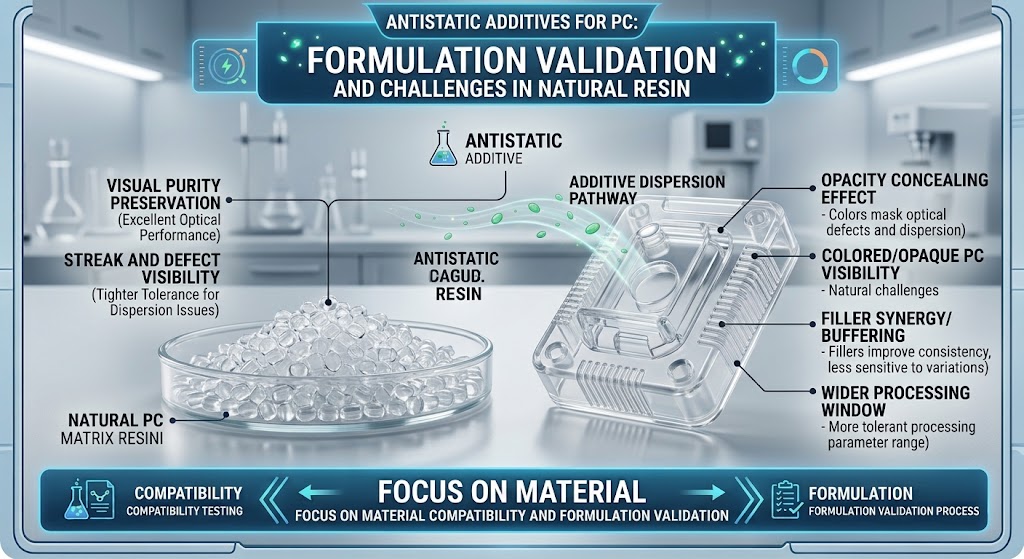
3. Why Is Natural-Color PC Particularly Challenging?
Natural-color PC generally refers to PC without an intentionally added colorant, although the resin itself may have a slight inherent tint.
Compared with black or dark-colored products, natural-color and light-colored products make visual changes easier to detect.
When an antistatic additive is introduced, several appearance-related issues may need attention.
3.1 Additive Color
Some additives have an inherent color or may change color under thermal processing.
Even a small color shift can be noticeable in a natural-color or light-colored product.
3.2 Dispersion and Surface Appearance
Poor dispersion or an unsuitable blend morphology may contribute to visible streaks, surface irregularities, or other defects.
The actual outcome depends on the additive, formulation, processing conditions, and product geometry.
3.3 Transparency and Optical Properties
For transparent or translucent PC products, the additive may affect light transmission, haze, or visual clarity.
Not every antistatic technology is suitable for applications requiring high optical transparency.
3.4 Balancing Electrical Performance and Appearance
A formulation may achieve the required surface resistivity but still be unsuitable if it causes unacceptable discoloration, haze, or surface defects.
Electrical performance and appearance must therefore be evaluated together.
Key point: Natural-color PC requires careful consideration of both the electrical target and the appearance specification. Neither should be evaluated in isolation.
4. How Should You Select an Antistatic Additive for PC?
Before selecting a product, confirm the following information.
1. Exact PC grade
Identify the resin grade and whether the material is virgin PC, a reprocessed material, or a formulated compound.
2. Processing method
Confirm whether the product is injection molded, extruded, or manufactured using another process.
3. Required electrical performance
Clarify the target surface resistivity or other electrical specification. Confirm the test method, temperature, relative humidity, and conditioning period.
4. Appearance requirements
Determine whether the finished product must be natural-color, light-colored, translucent, or transparent. Establish acceptable limits for color change, haze, and surface defects.
5. Mechanical requirements
Identify the required impact strength, tensile properties, stiffness, and dimensional stability.
6. Processing conditions
Confirm the recommended resin drying conditions, melt temperature, residence time, screw configuration, and other relevant processing parameters.
7. Durability and end-use conditions
Determine whether antistatic performance must be maintained after storage, environmental aging, repeated handling, or exposure to specific temperatures and humidity levels.
8. Regulatory and application requirements
For electrical, electronic, food-contact, or other regulated applications, confirm the relevant material, safety, and compliance requirements.
These details help determine whether a candidate additive is suitable and what validation tests are needed.
5. How Should Permanent Antistatic PC Be Tested?
A single surface resistivity result is not enough to establish that a formulation is suitable for every application.
A practical evaluation should consider several areas.
Electrical Performance
Measure surface resistivity using a defined test method and specified conditioning conditions. If required, evaluate volume resistivity or other electrical characteristics as well.
Appearance
Check color, transparency, haze, surface uniformity, and visible defects against the product specification.
Mechanical Properties
Evaluate the mechanical properties that are important to the intended application, such as impact strength and tensile performance.
Processing Stability
Observe melt behavior, extrusion stability, strand formation, pelletizing, or molding quality, depending on the manufacturing process.
Durability
Where relevant, assess performance after storage, heat aging, humidity exposure, or other conditions representative of actual use.
The test plan should reflect the customer’s requirements and the intended service environment.
6. Common Mistakes When Developing Antistatic PC Formulations
Several assumptions can lead to unnecessary formulation problems.
Assuming that one additive works equally well in every resin
An additive suitable for ABS or PP may not be suitable for PC without further evaluation.
Focusing only on surface resistivity
Meeting an electrical target does not guarantee acceptable color, mechanical properties, or processing stability.
Ignoring moisture control
Inadequate PC drying can affect melt processing and final properties, making it difficult to evaluate the additive correctly.
Changing multiple processing variables at once
Changing the additive loading, temperature settings, screw configuration, and drying conditions simultaneously can make troubleshooting difficult.
Skipping validation under actual processing conditions
Laboratory data is useful, but representative compounding and molding trials are often needed before confirming suitability for production.
Conclusion
Permanent antistatic modification of PC can be challenging because electrical performance must be balanced with compatibility, thermal stability, moisture control, mechanical properties, processing stability, and appearance.
Natural-color and transparent applications require particular attention because even minor changes in color or optical properties may be unacceptable.
The most reliable approach is to begin with the exact PC grade and application requirements, select an additive based on technical evidence, and validate the complete formulation under representative processing and testing conditions.