
Introduction
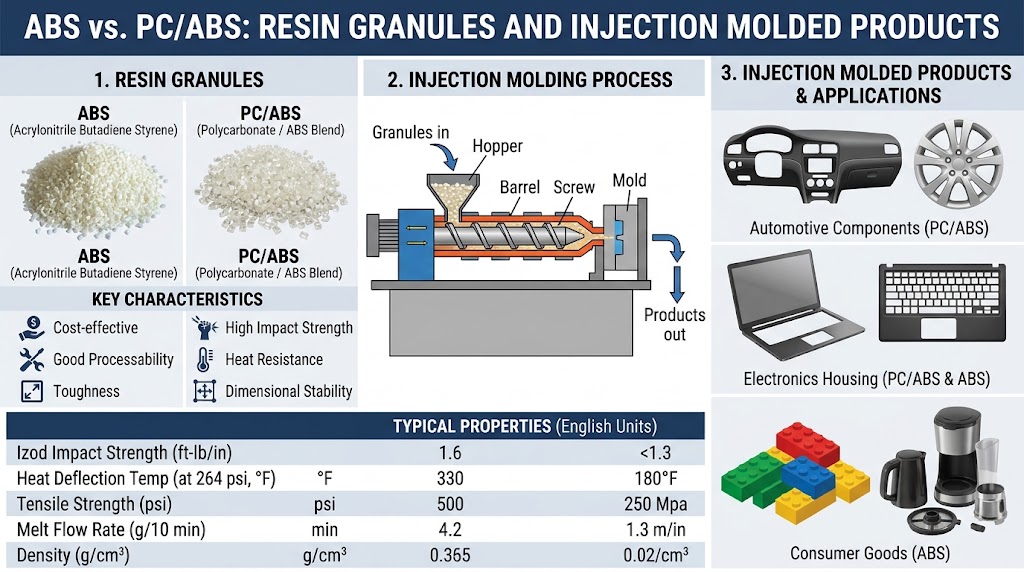
Acrylonitrile butadiene styrene (ABS) and polycarbonate/ABS blends (PC/ABS) are widely used in electrical housings, electronic equipment, automotive components, industrial enclosures, and other engineered plastic products.
However, these materials can accumulate static charges during manufacturing, handling, and use. Depending on the application, static electricity may attract dust, interfere with sensitive components, or create electrostatic discharge (ESD) concerns.
Antistatic additives can help address these challenges. However, selecting a suitable additive for ABS or PC/ABS requires careful consideration of polymer compatibility, processing conditions, mechanical properties, appearance, and electrical performance.
Although ABS and PC/ABS are related engineering plastics, they should not automatically be treated as interchangeable systems.
1. What Is the Difference Between ABS and PC/ABS?
1.1 ABS
ABS is a terpolymer containing acrylonitrile, butadiene, and styrene components. It combines useful impact resistance, processability, surface appearance, and dimensional stability.
It is commonly used in appliance housings, electronic enclosures, consumer products, and industrial components.
When selecting an antistatic additive for ABS, important considerations include:
-
Compatibility with the specific ABS grade
-
Processing temperature and thermal stability
-
Impact strength and stiffness
-
Surface appearance and color
-
Required surface resistivity or other electrical specifications
1.2 PC/ABS
PC/ABS is a blend of polycarbonate (PC) and ABS. Depending on the formulation, it can combine selected advantages of PC, such as heat resistance and toughness, with processing and impact-performance characteristics contributed by ABS.
PC/ABS is commonly used in electronic housings, automotive interiors, electrical components, and engineering applications.
When selecting an antistatic additive for PC/ABS, additional attention may be needed for:
-
Higher processing temperatures in some grades
-
Moisture control and resin drying requirements
-
Thermal stability during compounding and molding
-
Impact strength and other mechanical properties
-
Surface finish, color, and dimensional stability
Actual requirements vary with the resin grade and the proportion of PC in the blend.
2. Why Is Compatibility Important?
An antistatic additive must work with the polymer system in which it is used.
Compatibility influences how the additive distributes within the resin, how the material behaves during processing, and how consistently the finished product performs.
If the additive is poorly matched to the base resin, possible problems may include:
-
Uneven dispersion
-
Changes in melt behavior
-
Reduced mechanical performance
-
Surface defects or undesirable appearance
-
Inconsistent antistatic results
For polymeric permanent antistatic additives, the relationship between the additive and the base resin is particularly important.
The additive may need to form a suitable morphology within the polymer matrix to provide effective charge dissipation without compromising the final product’s required properties.
Important: Compatibility cannot be determined by polymer names alone. It should be evaluated using the specific resin grade, additive chemistry, formulation, and processing conditions.
3. Why Can Permanent Antistatic Modification Be Challenging?
Permanent antistatic modification of engineering plastics can be more demanding than simply adding a conventional surface-active antistatic agent.
Several factors need to be considered.
3.1 Dispersion and Morphology
The additive must be distributed appropriately throughout the polymer system.
Poor dispersion or an unsuitable phase structure may lead to inconsistent electrical performance and changes in mechanical properties.
The required morphology depends on the additive chemistry, resin composition, loading level, and processing conditions.
3.2 Processing Temperature and Thermal Stability
Different ABS and PC/ABS grades have different processing windows.
An additive must remain sufficiently stable under the actual compounding and molding conditions. Excessive thermal exposure may affect the additive, the resin, or both.
The recommended processing conditions should therefore be confirmed for the specific formulation rather than assumed to be identical across all grades.
3.3 Melt Behavior and Extrusion Stability
During compounding, the additive may influence melt viscosity, flow behavior, and extrusion stability.
Potential problems include unstable extrusion, difficult strand formation, or inconsistent pelletizing.
However, these problems do not necessarily indicate that the base polymer itself is unsuitable. They may result from additive compatibility, loading level, drying, temperature settings, screw configuration, or other formulation and process variables.
3.4 Mechanical Properties
Antistatic additives may affect impact strength, tensile properties, stiffness, elongation, and other mechanical characteristics.
The effect depends on the additive type, concentration, and interaction with the polymer matrix.
The final formulation must balance electrical performance with the mechanical properties required by the application.
3.5 Appearance and Color
For natural-color, light-color, or appearance-sensitive products, the additive’s color, dispersion, and influence on the surface may be important.
Some applications may also require transparency or a particular surface finish.
The acceptable trade-offs depend on the product design and customer specifications.
4. What About Natural-Color PC and PC/ABS?
Natural-color or light-colored engineering plastic products can present additional formulation challenges because visual defects are easier to notice.
When developing an antistatic formulation for natural-color PC or PC/ABS, consider:
-
The original color and appearance of the additive
-
Compatibility with the resin
-
Dispersion and phase structure
-
Thermal stability during processing
-
Changes in transparency, color, or surface finish
-
The effect on mechanical performance
A formulation that achieves a target surface resistivity may still be unsuitable if it causes unacceptable discoloration, surface defects, or loss of mechanical properties.
Electrical performance and appearance should therefore be evaluated together.
5. How Should You Select an Antistatic Additive for ABS or PC/ABS?
Before recommending a product, clarify the following information.
1. Exact base resin
Is the material ABS or PC/ABS? What is the resin grade, and, for PC/ABS, what blend composition is being used if known?
2. Processing method
Is the product injection molded, extruded, or manufactured through another process?
3. Required electrical performance
What surface resistivity or other electrical requirement must be achieved? Which test method, temperature, humidity, and conditioning period will be used?
4. Target appearance
Is the product black, natural-color, light-colored, or transparent? Are there strict requirements for surface finish or color consistency?
5. Mechanical requirements
What impact strength, tensile properties, stiffness, and dimensional stability must be maintained?
6. Processing conditions
What are the actual drying conditions, melt temperatures, screw configuration, and compounding or molding parameters?
7. Durability and compliance
Must the product retain antistatic performance after aging or environmental exposure? Are there specific industry, safety, or regulatory requirements?
The answers help determine whether a candidate additive is technically appropriate and what testing is necessary.
6. How Should Antistatic Performance Be Evaluated?
Surface resistivity is commonly used to evaluate antistatic plastic materials, but the result must be interpreted in context.
A meaningful evaluation should specify:
-
The test method
-
Temperature and relative humidity
-
Conditioning time
-
Whether the measurement is surface or volume resistivity
-
The number of specimens and repeatability of results
-
Any relevant aging or durability tests
For engineering plastics, electrical performance should be assessed alongside mechanical properties, appearance, and processing stability.
Passing a single electrical test does not automatically establish suitability for every ESD application.
Conclusion
ABS and PC/ABS are both important engineering plastics, but their different compositions and processing requirements can influence antistatic additive selection.
Successful permanent antistatic modification requires more than achieving a target electrical value. Compatibility, dispersion, processing stability, mechanical properties, appearance, and durability must all be considered.
The most reliable approach is to start with the exact resin grade and end-use requirements, select a suitable additive based on technical evidence, and validate the formulation under representative processing and testing conditions.