
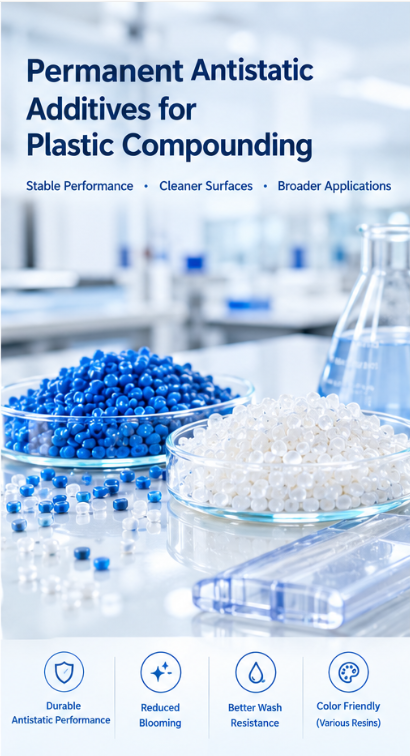
Introduction
Polypropylene (PP) and polyethylene (PE) are two of the most widely used thermoplastics in the plastics industry. They are commonly found in packaging, films, injection-molded products, containers, and industrial plastic components.
However, both PP and PE have relatively low electrical conductivity and can accumulate static charges during processing, handling, and use.
Antistatic agents can help reduce this problem, but selecting the right product requires more than simply knowing whether the base resin is PP or PE.
Although PP and PE share some similarities, their molecular structures, processing conditions, product designs, and performance requirements can differ significantly. These factors influence the selection and effectiveness of antistatic additives.
1. What Are the Differences Between PP and PE?
PP and PE are both polyolefins, but they have different molecular structures and physical properties.
Polypropylene (PP)
PP generally has a higher stiffness and heat resistance than common polyethylene grades. It is widely used in injection-molded parts, household products, automotive components, packaging, and some film applications.
When selecting an antistatic additive for PP, important considerations include:
-
Processing temperature and thermal stability
-
Compatibility with the PP formulation
-
Impact strength and stiffness requirements
-
Surface appearance and color
-
Required antistatic performance
Polyethylene (PE)
PE includes several grades, such as low-density polyethylene (LDPE), linear low-density polyethylene (LLDPE), and high-density polyethylene (HDPE).
These grades differ in density, crystallinity, flexibility, and processing behavior.
PE is commonly used in films, bags, containers, pipes, and industrial packaging.
When selecting an antistatic additive for PE, important considerations include:
-
The specific PE grade and formulation
-
Film extrusion, blown-film, or molding conditions
-
Flexibility and mechanical properties
-
Surface appearance and blocking behavior
-
Required antistatic performance and durability
Key point: PP and PE are related polymer families, but an additive that works well in one formulation may not deliver the same performance in another.
2. What Types of Antistatic Agents Can Be Used in PP and PE?
Several approaches may be considered, depending on the application.
2.1 Conventional Antistatic Additives
Conventional antistatic additives are often based on relatively low-molecular-weight compounds or surfactant-type materials.
Some migrate toward the material surface and interact with moisture, helping static charges dissipate.
Their performance may be influenced by humidity, storage time, surface conditions, and contact with water or other substances.
They can be suitable for applications where the required performance and service life are compatible with these limitations.
2.2 Polymeric Permanent Antistatic Additives
Polymeric antistatic materials, including certain polyether-amide and related polymer systems, can be incorporated into selected plastic formulations.
Depending on the chemistry and formulation, they may provide more durable antistatic performance than conventional surface-active treatments.
However, performance depends on factors such as:
-
Compatibility with the base resin
-
Additive loading
-
Dispersion during compounding
-
Processing temperature and shear conditions
-
Final product structure and testing conditions
These factors are particularly important when developing permanent antistatic PP and PE compounds.
2.3 Conductive Fillers and Conductive Masterbatches
Conductive carbon black, carbon nanotubes, and other conductive materials may be used when a higher level of conductivity or a specific static-dissipative performance is required.
These technologies operate differently from conventional antistatic additives.
They may affect color, mechanical properties, surface appearance, processability, and cost. The appropriate choice depends on the product’s electrical specifications and intended use.
3. Can the Same Antistatic Additive Be Used for Both PP and PE?
Sometimes, yes—but this should not be assumed without testing.
Certain antistatic additives are specifically designed for polyolefins and may be suitable for both PP and PE. However, suitability for both resin families does not guarantee identical performance.
For example, an additive may work well in a PP injection-molded part but behave differently in a thin PE film.
Possible reasons include differences in:
-
Polymer morphology and additive compatibility
-
Processing temperature and residence time
-
Film thickness or molded-part geometry
-
Additive concentration and dispersion
-
Surface conditions and environmental exposure
The correct approach is to confirm the additive supplier’s recommended resin grades, processing conditions, dosage range, and test data.
Where necessary, conduct trials using the actual resin formulation and manufacturing process.
4. How Does the Application Affect Antistatic Agent Selection?
The final product can be just as important as the base resin.
PP Injection-Molded Products
For PP injection-molded parts, the additive must be compatible with the molding process and should not unacceptably affect mechanical properties, appearance, or dimensional stability.
Typical applications include plastic housings, containers, trays, and industrial components.
PE Films and Packaging
For PE films, additive dispersion, film appearance, blocking behavior, mechanical properties, and winding performance may all matter.
The required antistatic performance may also depend on whether the film is used for general packaging, dust-sensitive products, or electrostatic-sensitive components.
HDPE Containers and Industrial Parts
For HDPE containers and molded industrial parts, selection should consider the processing conditions, impact resistance, product geometry, and required static-control performance.
A formulation suitable for a film application should not automatically be assumed to work equally well in a thick-walled molded product.
5. What Should You Check Before Selecting an Antistatic Additive?
Before recommending an antistatic solution for PP or PE, confirm the following information.
1. Base resin: Is it PP, LDPE, LLDPE, or HDPE? Is the material virgin resin or a compound containing other additives?
2. Processing method: Is the product injection molded, extruded, blown into film, or manufactured using another process?
3. Target electrical performance: What surface resistivity or other electrical requirement must the product meet? Which test method and conditioning conditions will be used?
4. Dosage: What loading range does the additive supplier recommend for the particular resin and application?
5. Product requirements: Are transparency, color, flexibility, impact strength, surface finish, or food-contact compliance important?
6. Durability: Must the product retain its antistatic performance after storage, repeated handling, washing, abrasion, or environmental aging?
7. Processing stability: Does the additive affect melt flow, extrusion stability, pelletizing, or molding performance?
These questions help narrow down suitable products and reduce unnecessary trial-and-error.
6. Common Challenges in Permanent Antistatic PP and PE Formulations
Even when an additive is designed for a particular polymer family, the final formulation may present challenges.
Inconsistent Electrical Performance
Differences in resin grade, additive concentration, dispersion, and processing conditions may cause variation in measured surface resistivity.
Processing Difficulties
An unsuitable additive concentration or poor compatibility may affect melt behavior, extrusion stability, pelletizing, or molded-part quality.
Changes in Mechanical Properties
The additive may affect stiffness, impact strength, elongation, or other properties, depending on the formulation.
Different Results Between Films and Molded Parts
Film thickness, product geometry, cooling conditions, and surface characteristics can influence the final performance.
For these reasons, antistatic additives should be evaluated in the intended formulation and under representative manufacturing conditions.
Conclusion
PP and PE share many characteristics as polyolefins, and certain antistatic additives can be suitable for both. However, resin grade, processing method, product design, electrical specifications, and durability requirements all influence the final result.
The best selection process begins with understanding the customer’s material and application, then verifying compatibility, dosage, processing stability, and electrical performance through appropriate testing.