Introduction
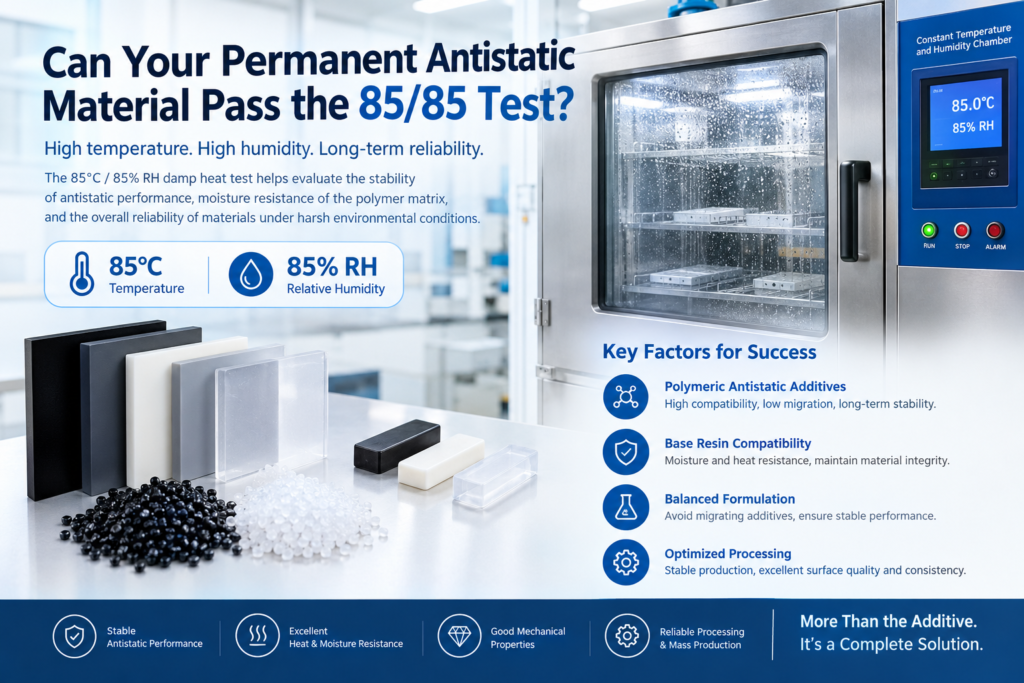
The 85°C/85% RH test, commonly known as the 85/85 damp heat test, is an important accelerated aging method for evaluating the reliability of polymer materials under high-temperature and high-humidity conditions.
By exposing materials to elevated temperature and humidity, the test helps evaluate the stability of antistatic performance, the moisture resistance of the polymer matrix, and potential weaknesses in formulation and processing.
For permanent antistatic materials, maintaining stable electrical performance after prolonged exposure to harsh environmental conditions is an important consideration, particularly in electronics, automotive components, outdoor plastic applications, and other demanding industrial environments.
However, passing an 85/85 test depends on the complete formulation, including the antistatic additive, base resin, other additives, and processing conditions. A test result should always be interpreted in the context of the specific material, specimen, and acceptance criteria.
1. Key Formulation Requirements for 85/85 Testing
Developing permanent antistatic materials for high-temperature and high-humidity environments requires a carefully balanced formulation. The following factors deserve particular attention.
1.1 Select a Suitable Polymeric Antistatic Additive
Polymeric antistatic systems, including certain polyether ester amide and polyether amide-based materials, can be considered when long-term antistatic performance is required.
Compared with conventional low-molecular-weight antistatic agents, suitable polymeric systems may offer reduced migration and better retention within the polymer matrix.
However, performance depends on the compatibility between the additive and the base resin, as well as the formulation and processing conditions. High-molecular-weight chemistry alone does not guarantee resistance to migration, extraction, or humidity-related performance changes.
1.2 Optimize the Moisture and Heat Resistance of the Base Resin
The base resin plays an important role in the overall reliability of the material.
Resin selection should consider moisture absorption, hydrolytic stability, thermal resistance, dimensional stability, and the intended service environment.
The additive loading and processing conditions must also be optimized to maintain the integrity of the material and its antistatic performance after aging.
1.3 Control the Use of Potentially Migrating Additives
Lubricants, plasticizers, release agents, and other low-molecular-weight ingredients may migrate to the surface under certain conditions.
Such migration can affect surface appearance, cleanliness, and electrical measurements. Formulation compatibility should therefore be evaluated carefully, especially for applications requiring clean surfaces or consistent electrostatic discharge (ESD) performance.
1.4 Optimize the Antistatic Additive Loading
The appropriate additive concentration depends on the resin, the processing method, the required surface resistivity, and the final application.
Insufficient loading may result in inadequate or inconsistent antistatic performance, while excessive loading may affect mechanical properties, processability, appearance, or environmental stability.
The optimum formulation should be established through application-specific testing rather than additive concentration alone.
2. Understanding the 85/85 Damp Heat Test
2.1 Test Conditions
The 85/85 test generally refers to exposure at:
-
Temperature: 85°C
-
Relative humidity: 85% RH
-
Exposure duration: Defined according to the applicable test plan and product requirements
IEC 60068-2-78 addresses damp heat testing under steady-state, high-humidity conditions without condensation. IEC 60068-2-67 covers accelerated damp heat testing for components or equipment where the test conditions and applicability are specified.
The exact temperature and humidity tolerances, specimen preparation, exposure duration, and measurement procedure should be defined by the applicable standard or customer specification.
2.2 Test Water and Chamber Conditions
The humidity chamber should be operated according to the equipment manufacturer’s instructions and the applicable test procedure. Water quality, chamber cleanliness, and contamination control should be managed to prevent unintended effects on the specimens.
2.3 Exposure Duration and Specimen Preparation
An exposure period of 168 hours may be used as a screening or evaluation condition in some applications. It should not be treated as a universal requirement for every permanent antistatic material.
Specimens should be prepared and conditioned consistently. Unless the application specifically requires a coating or protective layer, testing the uncoated material can help evaluate the performance of the material itself.
For meaningful comparisons, record the initial measurements and repeat the relevant measurements after exposure. Additional measurements during aging may be included when required by the test plan.
3. How to Evaluate Material Performance After 85/85 Testing
A useful evaluation should consider appearance, electrical properties, and mechanical or dimensional performance.
3.1 Appearance
Inspect the specimens for:
-
Whitening or discoloration
-
Blooming or visible additive deposits
-
Blistering, cracking, or delamination
-
Surface changes or other visible defects
Any observed changes should be documented and assessed against the product’s acceptance criteria.
3.2 Electrical Performance
Surface resistivity and volume resistivity, where relevant, should be measured using an appropriate method under controlled conditions.
For many ESD-related applications, the required resistance range depends on the end use and the applicable ESD specification. A range such as 10⁶–10¹¹ Ω may be relevant to certain applications, but it is not a universal acceptance range for all antistatic plastics.
The initial and post-aging results should be compared to determine whether the material remains within the specified limits.
A change of one order of magnitude or less may be adopted as a project-specific target in some cases, but it is not a universal pass/fail requirement of the 85/85 test.
3.3 Mechanical and Dimensional Stability
Depending on the application, evaluation may include:
-
Tensile strength and elongation at break
-
Dimensional change
-
Warpage or deformation
-
Cracking or other structural defects
A mechanical-property retention target, such as 85% or higher, may be established for a particular project. The appropriate acceptance limit should be determined by the base resin, product design, and customer requirements.
4. What to Look for in a Permanent Antistatic Material
For applications involving high humidity and elevated temperatures, the following characteristics are worth evaluating.
4.1 Stable Antistatic Performance
A suitable polymeric antistatic system should maintain the required electrical performance after exposure to the specified environment. Surface appearance and potential additive migration should also be evaluated.
4.2 Limited Electrical Drift
Electrical performance should remain within the application’s acceptance limits after aging. Both the absolute resistance values and changes relative to the initial measurements matter.
4.3 Suitable Heat and Moisture Resistance
The complete material formulation should retain the necessary structural, mechanical, and dimensional properties under the intended operating conditions.
4.4 Reliable Processing and Production Consistency
Injection molding, extrusion, and other processing methods may impose different requirements on the material.
Processing stability, dispersion, surface quality, mold release, and batch-to-batch consistency should all be considered during material qualification.
Conclusion
The reliability of a permanent antistatic polymer under 85°C/85% RH conditions depends on more than the antistatic additive alone.
The base resin, additive compatibility, formulation design, processing conditions, and test methodology all contribute to the final result.
Selecting a suitable polymeric antistatic system and validating it through controlled aging tests can help manufacturers develop plastic materials with more consistent electrical performance and long-term reliability.
Before selecting a permanent antistatic additive for a demanding application, define the target resistance, base resin, processing method, and aging requirements. These details provide a more reliable basis for material selection and qualification.
If you are evaluating permanent antistatic additives for PP, PE, ABS, PC, or other plastic systems, contact us to discuss your material requirements and application conditions.
SEO Title: Can Permanent Antistatic Polymers Pass the 85/85 Test?
Meta Description: Learn how polymeric antistatic additives, base resin selection, and formulation design affect electrical stability and material reliability under 85°C/85% RH aging conditions.
URL Slug: permanent-antistatic-polymers-85-85-test
Focus Keyword: permanent antistatic polymers
Related Keywords: 85/85 damp heat test, polymeric antistatic additives, permanent antistatic plastics, surface resistivity, ESD materials