
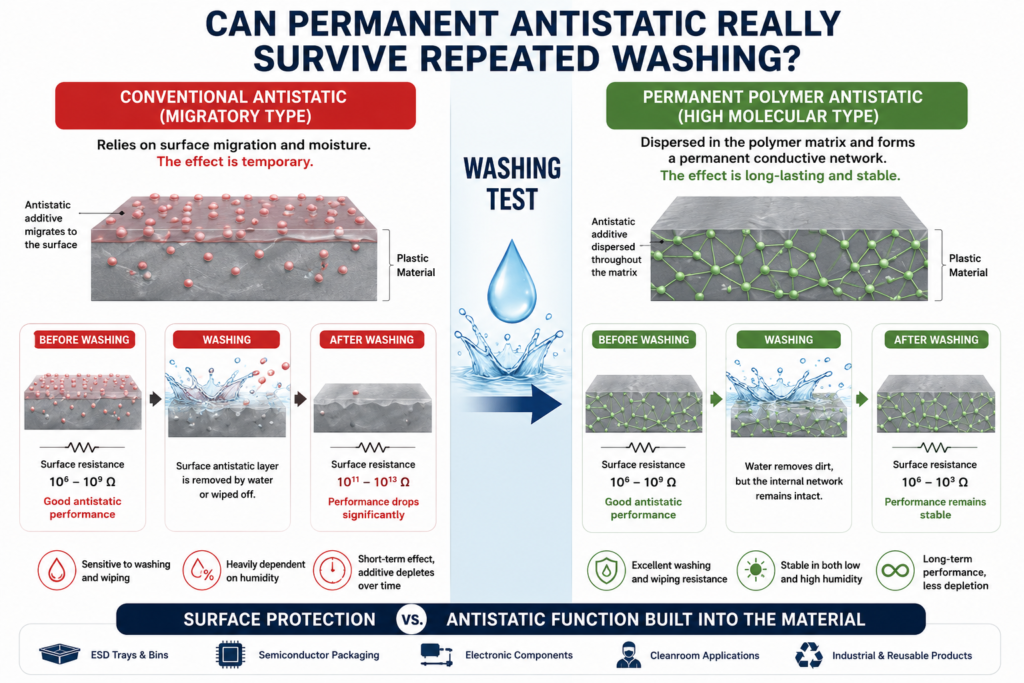
For electronics manufacturers, plastic compounders, and packaging producers, antistatic performance is often expected to remain stable throughout the service life of a product.
However, a common problem with conventional antistatic materials is that their performance may gradually decline after repeated washing, wiping, or long-term use.
Surface resistivity increases, static electricity becomes more difficult to dissipate, and problems such as dust attraction, electrostatic discharge, and contamination of sensitive electronic components may occur.
This raises an important question:
Can permanent polymer antistatic additives really maintain their antistatic performance after repeated washing, or is “wash-resistant” simply a marketing claim?
The answer depends on the material structure and the antistatic mechanism.
Why Do Conventional Antistatic Additives Lose Performance After Washing?
Many conventional antistatic additives are based on small-molecule migratory systems.
After being incorporated into a plastic material, these additives gradually migrate toward the surface. They can interact with moisture in the surrounding environment to create a pathway for dissipating electrostatic charges.
This mechanism can provide an effective and economical antistatic solution, but it also creates several limitations.
1. Washing and wiping can reduce the surface effect
Because part of the antistatic function depends on material present near the surface, repeated washing or wiping can remove or reduce the effective surface layer.
As a result, surface resistivity may increase.
2. Performance can depend on humidity
Migratory antistatic systems often rely partly on moisture to improve charge dissipation.
Under low-humidity conditions, the amount of moisture available at the surface decreases, which can lead to higher surface resistivity.
3. Long-term performance may decrease
Over time, continuous migration, surface removal, and depletion of the active additive can gradually reduce antistatic performance.
This is one reason why some reusable plastic trays, containers, and other antistatic products may perform well when new but show higher resistance after repeated cleaning or extended use.
Why Are Permanent Polymer Antistatic Additives Different?
Permanent polymer antistatic additives use a fundamentally different approach.
Typical systems include polyether-based block copolymers and other polymeric antistatic structures.
During melt processing, the antistatic additive is dispersed throughout the polymer matrix. When the formulation is properly designed, the additive can form a continuous or interconnected charge-dissipation network within the material.
In simple terms:
The antistatic function is integrated into the material rather than simply being present as a temporary surface effect.
This is the key difference between migratory antistatic additives and permanent polymer antistatic systems.
Because the antistatic function is distributed throughout the material, ordinary surface washing or wiping does not simply remove the entire antistatic system.
This can provide significantly better durability for applications involving repeated cleaning and long-term reuse.
How Many Washing Cycles Can a Permanent Antistatic Material Withstand?
The actual washing durability depends on the polymer, additive type, dosage, processing conditions, washing method, temperature, chemicals used, and test standard.
For this reason, washing-cycle claims should always be supported by actual test data under defined conditions.
In standardized washing tests, properly formulated permanent antistatic materials can demonstrate strong resistance to repeated washing, with relatively stable surface resistivity before and after testing.
However, there is no universal number of washing cycles that applies to every permanent antistatic formulation.
A product that performs well in repeated water washing may behave differently under strong alkaline cleaning, high-temperature washing, solvents, or severe mechanical abrasion.
Therefore, the correct approach is to evaluate the material under the actual conditions of use.
Does “Permanent” Mean the Material Can Never Lose Its Antistatic Performance?
No.
“Permanent antistatic” should not be interpreted as “the material can never fail.”
There are still practical limits.
1. Extreme service conditions can affect performance
Strong acids or alkalis, prolonged exposure to high temperatures, aggressive cleaning conditions, and severe mechanical wear can eventually affect the polymer matrix and the internal antistatic network.
In these conditions, some reduction in antistatic performance may occur.
2. Insufficient additive loading can reduce effectiveness
The additive dosage is also critical.
If the loading level is too low, the antistatic network may not be sufficiently developed throughout the polymer matrix.
The result can be unstable or insufficient antistatic performance, including resistance fluctuations after washing.
This is why simply adding a “permanent antistatic additive” does not automatically guarantee permanent antistatic performance.
The polymer matrix, additive structure, dosage, dispersion, processing conditions, and final application all need to be considered together.
Is a Permanent Polymer Antistatic Additive Worth Choosing?
The answer depends on the application.
For short-term or disposable products
If the product is used only for a short period and cost is the main consideration, a conventional migratory antistatic system may be sufficient.
For reusable and long-term applications
For products that require repeated cleaning, long-term circulation, or stable ESD performance, a permanent polymer antistatic system can provide significant advantages.
Typical applications include:
Electronic packaging
Semiconductor handling
ESD trays and containers
IC and precision component packaging
Industrial reusable containers
Automotive plastic components
Cleanroom-related plastic products
The main advantages can include:
Better washing durability
Lower dependence on surface migration
More stable long-term performance
Reduced risk of additive loss from the surface
Better suitability for reusable products
Permanent Antistatic Is More Than a Marketing Term
The key difference is not simply whether a product is called “antistatic.”
The real difference lies in how the antistatic function is created and maintained inside the polymer material.
Conventional migratory antistatic systems:
Surface-dependent → temporary effect → more sensitive to washing and humidity
Permanent polymer antistatic systems:
Integrated into the polymer matrix → long-term charge dissipation → better suited to repeated-use applications
Therefore, when selecting an antistatic additive, the most important questions are not simply:
“Is it permanent?”
“Is it washable?”
Instead, manufacturers should evaluate:
What is the antistatic mechanism?
What is the recommended dosage?
How stable is the surface resistivity?
How does it perform after washing?
How does it behave under the actual service conditions?
That is how to distinguish a genuine permanent antistatic solution from a simple marketing claim.