
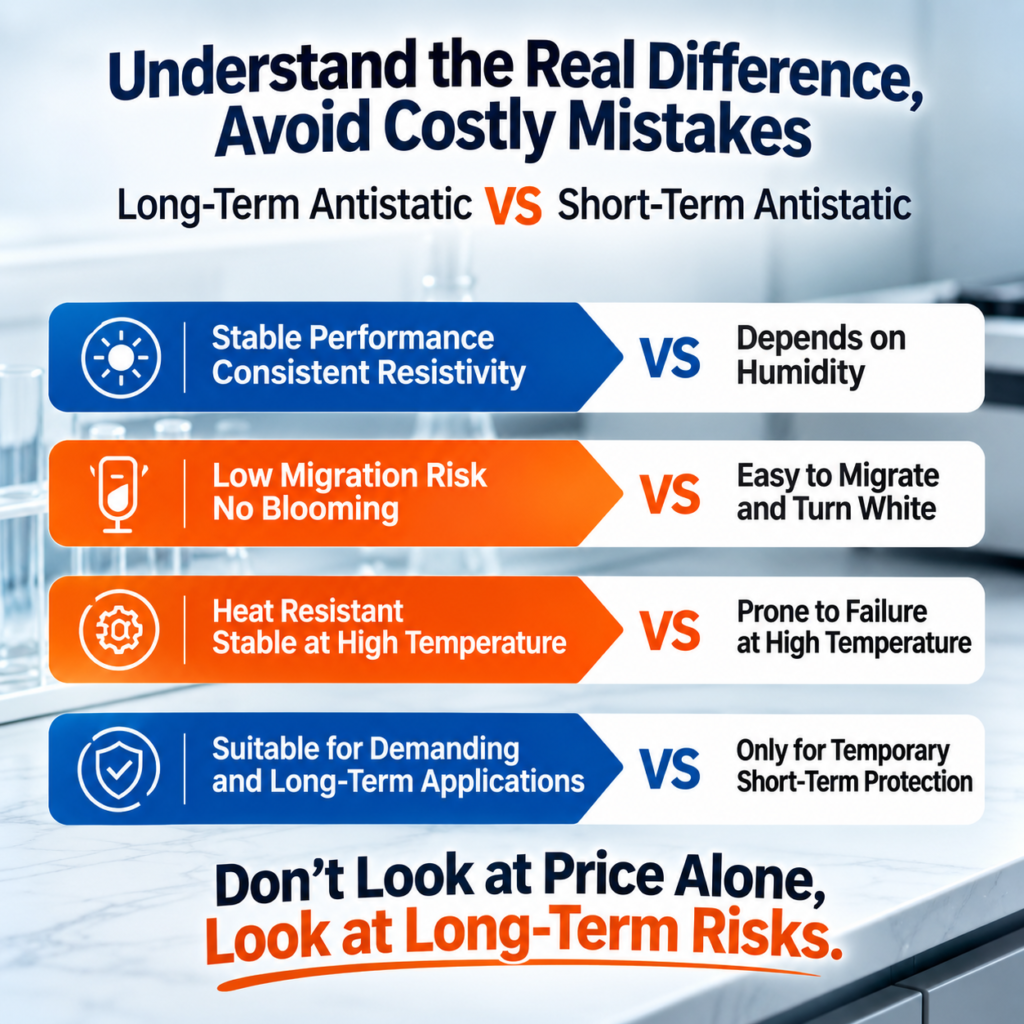
Both materials can pass an antistatic test. So why can their prices differ by 50% or even 100%?
To an outsider, both are simply “antistatic materials.”
To a plastics professional, however, long-term and short-term antistatic solutions are fundamentally different.
Choosing the wrong one can lead to unstable surface resistivity, dust attraction, coating or printing problems, failed ESD inspections, product returns, and even large-scale production losses.
In many cases, the root cause is simple:
A short-term antistatic material is being used for a long-term application.
Same Result on the Surface, Completely Different Mechanisms
Short-Term Antistatic: Depends on Moisture
Short-term antistatic agents typically work through the migration of small-molecule additives to the plastic surface.
These additives absorb moisture from the surrounding air and form a thin conductive layer that helps dissipate static electricity.
In simple terms:
It relies on humidity to work.
Performance can look good in humid conditions, but in dry environments—such as winter, air-conditioned rooms, or low-humidity production areas—the antistatic performance can decrease significantly.
Because the additives gradually migrate to the surface, they can also be consumed or removed through wiping, friction, and washing.
This makes short-term antistatic protection essentially a consumable surface treatment.
Long-Term Antistatic: Built Into the Material
Long-term antistatic systems work differently.
Depending on the formulation, conductive fillers or permanent antistatic polymers can establish a stable conductive or charge-dissipation structure within the polymer matrix.
The antistatic function is therefore integrated into the material rather than relying on continuous migration to the surface.
No surface migration. Less dependence on ambient humidity. Long-lasting performance.
As long as the plastic product itself remains functional, the antistatic performance can be maintained for its intended service life.
5 Key Differences You Need to Know
1. Stability: “Depends on the Weather” vs. “Depends on the Formulation”
Short-term antistatic
Surface resistivity can vary significantly with temperature and humidity. Performance may be acceptable in humid conditions but deteriorate in dry environments, creating a higher risk of ESD test failures.
Long-term antistatic
A properly designed formulation provides much more stable and controllable surface resistivity across different environmental conditions, making it more suitable for standardized production and ESD-controlled applications.
2. Appearance & Secondary Processing
Short-term antistatic
Migrating additives may cause surface blooming, whitening, tackiness, or other appearance problems over time.
These issues can interfere with processes such as:
Printing
Painting
Coating
Bonding
Surface treatment
This can be particularly problematic for appearance-critical and export products.
Long-term antistatic
When the antistatic system is properly incorporated into the polymer matrix, it can provide low-migration performance and better surface stability, helping maintain appearance and compatibility with secondary processing.
3. Service Life
Short-term antistatic
Generally more suitable for disposable products, temporary packaging, or short-term applications where long-term antistatic performance is not required.
Long-term antistatic
Designed for applications where antistatic performance needs to remain effective throughout the service life of the product, including repeated handling, friction, wiping, and long-term storage.
4. Processing Temperature
Short-term antistatic
Some conventional antistatic additives may have limited thermal stability and can lose effectiveness during high-temperature processing, depending on the chemistry and processing conditions.
Long-term antistatic
A properly selected permanent antistatic system can offer better thermal stability and can be designed for engineering plastics and high-temperature processing applications.
The suitable solution depends on the polymer, processing temperature, residence time, and required surface resistivity.
5. Cost: Lower Material Cost Does Not Always Mean Lower Total Cost
Short-term antistatic materials may have a lower purchase price.
But if they cause:
Unstable resistivity
Product rejection
Surface defects
Production rework
Customer complaints
Product returns
the actual cost can become much higher.
A long-term antistatic solution may require a higher initial material investment, but it can reduce quality risks and improve consistency in long-term production.
Where Should You Use Short-Term Antistatic?
Short-term solutions may be suitable for:
Simple packaging films
Temporary protective packaging
Short-term turnover products
General industrial products without strict ESD requirements
Disposable applications
The key is that the application does not require long-term, highly stable antistatic performance.
Where Is Long-Term Antistatic Recommended?
Long-term antistatic solutions are more appropriate for demanding applications such as:
IC trays and semiconductor packaging
Carrier tapes and PCB handling products
New energy and battery-related components
Precision injection-molded parts
Cleanroom applications
Electronic and medical components
Products requiring painting, printing, or coating
Reusable industrial bins and fixtures
Products subject to regular ESD inspection
Export products with strict quality requirements
The Bottom Line
The difference between short-term and long-term antistatic materials is not simply the price or whether they can pass one antistatic test.
The real difference lies in:
stability, service life, environmental dependence, surface behavior, processing compatibility, and production risk.
If your product needs stable antistatic performance throughout its service life, choosing a long-term antistatic solution can help reduce the risk of resistivity drift, surface migration, product rejection, and customer complaints.
Don’t choose an antistatic material only because it passes today’s test.
Choose it based on how your product will be used tomorrow.